
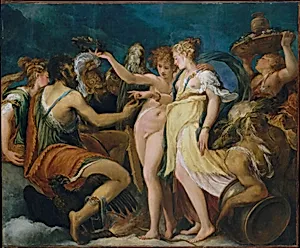
The Marriage of Cupid and Psyche
Medium
Oil on wood, transferred to Masonite
Dimensions
Overall, with corners made up, 51 1/2 x 61 7/8 in. (130.8 x 157.2 cm); painted surface 50 1/2 x 61 1/2 in. (128.3 x 156.2 cm)
Classification
Paintings
Department
European Paintings
Museum
Metropolitan Museum of Art, New York, NY
Credit
Purchase, Gift of Mary V. T. Eberstadt, by exchange, 1972
Accession Number
1973.116
Rights
Public Domain
Tags
Art Historical Context
The Marriage of Cupid and Psyche captures a beloved episode from ancient Roman literature, in which the mortal Psyche weds the god of love. Painted around 1540 by Andrea Schiavone, the work reflects the Renaissance fascination with classical myths as vehicles for exploring themes of desire, transformation, and divine union. Schiavone, active in Venice, presents the couple surrounded by attendant figures, emphasizing both the tenderness of their bond and the sensual beauty of the human form through prominent male and female nudes. Executed in oil on wood—a medium prized in the sixteenth century for its luminous color and fine detail—the painting has survived in remarkable condition despite its transfer to a modern Masonite support. This conservation history underscores the enduring appeal of mythological subjects in European collections. At roughly four by five feet, the canvas invites close viewing of its graceful figures and rich palette, inviting viewers to appreciate how Renaissance artists blended narrative drama with idealized beauty. Today in the Metropolitan Museum of Art’s European Paintings galleries, the work offers a window into sixteenth-century cultural values that celebrated love and artistic invention. Its presence in the collection, acquired through thoughtful exchange, highlights the museum’s ongoing commitment to preserving these timeless stories for new generations.
About the Artist
Andrea Schiavone (Andrea Meldola) · 1510–1563
Andrea Schiavone, born Andrea Meldolla around 1510 or 1515 in Zara (modern Zadar, Croatia), in Venetian-ruled Dalmatia, hailed from a family rooted in Meldola near Forlì in Romagna, Emilia-Romagna. His father, Simon Meldolla, served as a garrison commander there, and both parents originated from Meldola, where the family held property into the early 16th century. Nicknamed "Schiavone"—"the Slav"—a...