
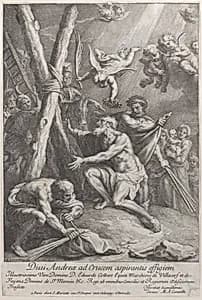
The Martyrdom of Saint Andrew
Medium
Etching; third state of three
Dimensions
Sheet (Trimmed): 11 13/16 × 7 15/16 in. (30 × 20.2 cm)
Classification
Prints
Department
Drawings and Prints
Museum
Metropolitan Museum of Art, New York, NY
Credit
Purchase, Joseph Pulitzer Bequest, 1917
Accession Number
17.50.15-49
Rights
Public Domain
Art Historical Context
In the late 17th century, French artists Jean Mariette and Michel Corneille the Younger collaborated on *The Martyrdom of Saint Andrew*, an etching capturing the dramatic crucifixion of the apostle on his iconic X-shaped cross. Created between 1690 and 1699, this print reflects the Baroque era's intense focus on religious fervor and emotional storytelling, evoking the Counter-Reformation's emphasis on saints' sacrifices to inspire faith. Saint Andrew, brother of Saint Peter and patron of Scotland and fishermen, meets his fate with steadfast piety amid tormentors, a scene rich in spiritual symbolism. As a third state of three from the etching plate, this work highlights the meticulous process of printmaking: artists revised plates across states to refine lines, shading, and details before final impressions. Etching's fluid technique allowed Corneille's academic precision—honed through his training in Paris and Rome—to shine, producing intricate textures on the trimmed sheet measuring 11 13/16 × 7 15/16 inches. Acquired in 1917 via the Joseph Pulitzer Bequest, it resides in the Metropolitan Museum of Art's Drawings and Prints department, exemplifying how prints democratized grand religious art for wider audiences. Visitors to the Met can appreciate this piece's enduring power, bridging technical innovation with timeless tales of devotion.
About the Artist
Jean Mariette|Michel Corneille the Younger (French) · 1694 –1774
French, Paris 1694–1774 Paris