
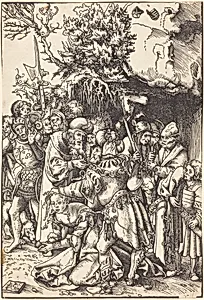
The Martyrdom of Saint Barbara
1401 to 1500
Medium
woodcut
Classification
Department
CG-E
Museum
National Gallery of Art, Washington, D.C.
Credit
Rosenwald Collection
Accession Number
1943.3.2845
Rights
Public Domain
Art Historical Context
Behold *The Martyrdom of Saint Barbara*, a striking woodcut by Lucas Cranach the Elder, a master of the German Renaissance (c. late 15th century). Part of the National Gallery of Art's Rosenwald Collection, this print captures the dramatic legend of Saint Barbara, a 3rd-century Christian martyr beheaded by her pagan father for refusing to renounce her faith. Cranach, court painter to the Electors of Saxony and a pioneer in printmaking, infused his works with vivid Northern Renaissance style—characterized by intricate details, expressive figures, and a focus on religious devotion. Woodcuts like this one were revolutionary in the 15th century, allowing artists to produce affordable, multiple copies of images that spread biblical stories and saints' lives across Europe. Cranach's technique involved carving designs into wood blocks, inking them, and pressing onto paper, resulting in bold lines and textured shading that heighten the scene's emotional intensity. Saint Barbara's poised defiance amid torment exemplifies the era's emphasis on faith's triumph over persecution. This print not only showcases Cranach's skill in merging painting finesse with print efficiency but also reflects the cultural fervor of late medieval piety, making sacred narratives accessible to pilgrims, worshippers, and the devout. A testament to art's power to inspire, it invites us to ponder endurance and spirituality.
About the Artist
Lucas Cranach the Elder · 1472–1553
Lucas Cranach the Elder (c. 1472-1553) was one of the most prominent German Renaissance painters and a key artistic figure of the Protestant Reformation. Born in Kronach, Franconia, to the painter Hans Maler, Cranach began his career in Vienna around 1502, where he became one of the founders of the Danube School, a movement characterized by expressive landscape painting and emotional force. His ea...