
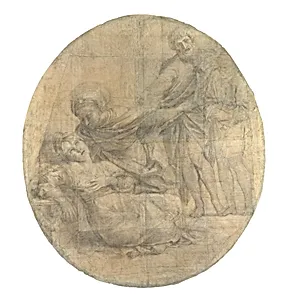
The Martyrdom of Saint Cecilia (Cartoon for a Fresco)
Medium
Charcoal highlighted with white chalk on fourteen sheets of blue laid paper, two of the sheets cut from elsewhere on the original cartoon and reset at the left and right margins to make up the oval
Dimensions
Irregular oval: 67 13/16 × 59 9/16 in. (172.2 × 151.3 cm)
Classification
Drawings
Department
Drawings and Prints
Museum
Metropolitan Museum of Art, New York, NY
Credit
Wrightsman Fund, 1998
Accession Number
1998.211
Rights
Public Domain
Tags
Art Historical Context
Domenichino's *The Martyrdom of Saint Cecilia (Cartoon for a Fresco)*, created between 1612 and 1614, is a monumental preparatory drawing by the Italian Baroque master Domenico Zampieri (1581–1641). A leading figure in the Bolognese school and pupil of the Carracci brothers, Domenichino excelled in fresco cycles for Roman churches, blending classical harmony with emotional intensity. This cartoon served as a full-scale blueprint for a fresco, likely intended for a chapel honoring Saint Cecilia, the patron saint of music, whose dramatic martyrdom—beheading after surviving earlier tortures—captures the era's fascination with sacred drama and Counter-Reformation fervor. Crafted from charcoal highlighted with white chalk on fourteen sheets of blue laid paper, the work forms an irregular oval measuring nearly six feet across (67 13/16 × 59 9/16 in.). Two sheets were ingeniously cut and reset at the margins, revealing the artist's meticulous process of enlargement and adjustment from smaller studies. The blue paper provides a subtle tonal ground, enhancing the luminous effects of the chalk highlights on figures' musculature and drapery, a technique that showcases Domenichino's draftsmanship rivaling Raphael's. Preserved in the Metropolitan Museum of Art's Drawings and Prints department (Wrightsman Fund, 1998), this rare surviving cartoon offers a window into 17th-century workshop practices. It immortalizes intertwined male and female figures in a scene of piety and violence, underscoring Domenichino's influence on Baroque narrative art and the enduring cultural reverence for saints' lives.