
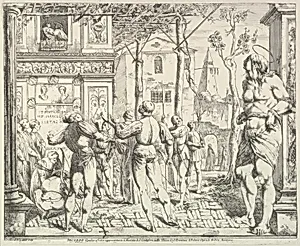
The Martyrdom of Saint Christopher, from "The Story of Saints James and Christopher in the Eremitani Chapel"
Medium
Etching; second state of two
Dimensions
Sheet (Trimmed to plate): 12 13/16 × 15 5/8 in. (32.5 × 39.7 cm)
Classification
Prints
Department
Drawings and Prints
Museum
Metropolitan Museum of Art, New York, NY
Credit
The Elisha Whittelsey Collection, The Elisha Whittelsey Fund, 1959
Accession Number
59.570.244
Rights
Public Domain
Tags
Art Historical Context
This evocative etching, *The Martyrdom of Christopher*, captures a dramatic scene from Andrea Mantegna's renowned fresco cycle *The Story of Saints James Christopher* in Padua's Eremitani Chapel (also known as the Ovet Chapel). Created by engraver Giovanni David after Mgna's designs, it belongs to the second state of two, a refined version likely showing enhanced details. Mantegna, a pioneering Early Renaissance artist (1431–1506), painted the original frescoes between 1448 and 1457, revolutionizing mural art with his masterful use of perspective, architectural illusion, and emotional intensity—hallmarks of the period's shift toward naturalism and classical revival. Etching, a printmaking technique using acid to bite lines into a metal plate, allowed works like this to disseminate Mantegna's genius widely during the Renaissance, preserving imagery for collectors and scholars. Tragically, the chapel's frescoes were destroyed in a 1944 WWII bombing, making such prints invaluable records. Here, Saint Christopher endures martyrdom amid houses and figures wielding bows and arrows, embodying the saint's legendary endurance and Christian fortitude. Measuring 12 13/16 × 15 5/8 inches, this sheet from The Metropolitan Museum of Art's Elisha Whittelsey Collection invites us to ponder resilience through art's enduring legacy. (198 words)
About the Artist
Giovanni David|Andrea Mantegna · 1749–1790
Giovanni David (1743–1790) was a Genoese painter and etcher whose brief career, shaped by distinguished patronage and wide-ranging travel, produced a body of work remarkable for its experimental verve. Born in Genoa, he came under the protection of Count Giacomo Durazzo, a cultivated Genoese nobleman and diplomat who became the defining figure of his artistic life. Durazzo sponsored David's traini...