
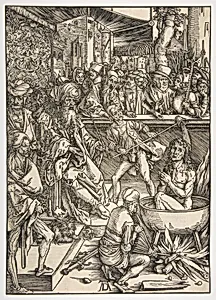
The Martyrdom of Saint John, from "The Apocalypse", Latin Edition
ca. 1511
Medium
Woodcut
Dimensions
sheet: 15 5/16 x 10 15/16 in. (38.9 x 27.8 cm)
Classification
Prints
Department
Drawings and Prints
Museum
Metropolitan Museum of Art, New York, NY
Credit
Bequest of Grace M. Pugh, 1985
Accession Number
1986.1180.66
Rights
Public Domain
Tags
Art Historical Context
Albrecht Dürer's *The Martyrdom of John, from "The Apocalypse", Latin Edition (ca. 1511) is a powerful wood from the renowned German artist's seminal series illustrating the Book of Revelation. during the Northern Renaissance, this print captures the intense suffering of Saint John—likely the Evangelist, visionary of the Apocalypse—amidst dramatic biblical torment. Dürer, a master printmaker, produced the original German *Apocalypse* series in 1498, with this Latin edition reflecting his enduring popularity across Europe, especially amid Reformation-era religious fervor. As a woodcut on a large sheet (15 5/16 x 10 15/16 in.), the work showcases Dürer's revolutionary technique: intricate lines carved into wood blocks allowed for bold contrasts, dynamic compositions, and mass production, elevating prints from mere illustrations to fine art. His meticulous attention to detail—expressive faces, swirling drapery, and symbolic motifs—conveys profound emotion and theological depth, making complex eschatological themes accessible to lay audiences. Housed in the Metropolitan Museum of Art's Drawings and Prints department (Bequest of Grace M. Pugh, 1985), this piece highlights Dürer's cultural impact, blending artistry with Protestant propaganda. It invites visitors to ponder themes of faith, martyrdom, and divine judgment through one of history's greatest visual storytellers.
About the Artist
Albrecht Dürer · 1471–1528
Albrecht Dürer (1471–1528) stands as the preeminent figure of the Northern Renaissance and arguably the most influential artist in the history of printmaking. Born in Nuremberg on May 21, 1471, and dying in the same city on April 6, 1528, Dürer revolutionized the status of the artist in Northern Europe, transforming printmaking from a commercial craft into an independent fine art and establishing ...