
The Martyrdom of Saint Lawrence
1551 to 1600
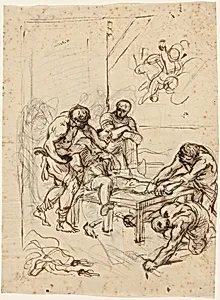
Medium
pen and brown and gray ink over black chalk on laid paper; with irregularly cut and torn patches attached and drawn with compositional corrections in pen and brown ink and black chalk
Dimensions
sheet: 36.7 x 26.8 cm (14 7/16 x 10 9/16 in.)
Classification
Drawing
Department
CG-E
Museum
National Gallery of Art, Washington, D.C.
Credit
Joseph F. McCrindle Collection
Accession Number
2009.70.92
Rights
Public Domain
Art Historical Context
Lodovico Carracci's *The Martyrdom Saint Lawrence*, created in the late 16 century, captures a dramatic moment from Christian hagiography: the gruesome execution of the 3rd-century deacon Lawrence on a gridiron, a popular subject in Counter-Reformation art symbolizing faith's triumph over persecution. As a leading figure in Bologna's artistic revival alongside his cousins Annibale and Agostino, Carracci rejected Mannerist excesses for a more naturalistic, classically inspired approach, blending emotional intensity with anatomical precision. This preparatory drawing exemplifies the Carracci workshop's innovative techniques. Executed in pen and brown and gray ink over black chalk on laid paper (36.7 x 26.8 cm), it features irregularly cut and torn patches meticulously attached and revised with additional ink and chalk. These corrections reveal the artist's iterative process, heightening the composition's dynamic energy and spatial depth—hallmarks of the emerging Baroque style. Housed in the National Gallery of Art's Joseph F. McCrindle Collection (Department CG-E), the work underscores drawings' vital role in Renaissance practice, serving as studies for larger paintings or frescoes. Visitors will appreciate how Carracci's masterful handling of light, shadow, and gesture foreshadows the grandeur of 17th-century masters like Rubens.
About the Artist
Lodovico Carracci · 1555–1619
Lodovico's style is charaterized by being less classical than that of his younger cousins, Agostino and Annibale, his figures have a sense of other-worldliness, and he is more influenced by Mannerist art than his cousins. Like his cousins, he espoused the direct study of nature, especially through figure drawing; he was influenced by the paintings of Correggio and the Venetians.