
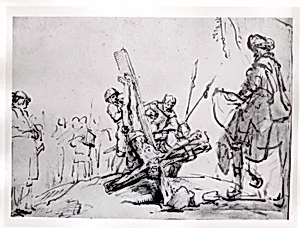
The Martyrdom of Saint Peter
late 1650s
Medium
Reed pen and brush and brown ink and brown wash.
Dimensions
7 15/16 x 10 13/16 in. (20.1 x 27.4 cm)
Classification
Drawings
Culture
Dutch
Department
Robert Lehman Collection
Museum
Metropolitan Museum of Art, New York, NY
Credit
Robert Lehman Collection, 1975
Accession Number
1975.1.793
Rights
Public Domain
Tags
Art Historical Context
In the late 1650s, during the Dutch Golden Age, artists from the School of Rembrandt van Rijn produced masterful drawings like *The Martyrdom of Peter*. This poignant work captures the dramatic moment of Saint Peter's upside-down crucifixion, a traditional symbol of humility and faith in Christian iconography. Attributed to Rembrandt's workshop or close followers, it reflects the master's influence in depicting profound human suffering and spiritual intensity, themes central to 17th-century Dutch religious amid a Protestant society that still revered biblical narratives. Executed in reed pen and brush with brown ink and brown wash on paper (7 15/16 x 10 13/16 in.), the drawing showcases virtuoso techniques of the period. The reed pen allowed for bold, expressive lines, while the brown wash added depth and subtle tonal modeling, evoking Rembrandt's signature chiaroscuro effects even in monochrome. Such preparatory sketches were vital in Rembrandt's circle for exploring composition and emotion before paintings or etchings. Housed in the Robert Lehman Collection at The Metropolitan Museum of Art, this Dutch masterpiece highlights the technical innovation and emotional power of Rembrandt's school, offering visitors a window into the artistry that defined Europe's Baroque era. Its focus on suffering and the cross underscores enduring cultural reverence for Saint Peter as the foundational apostle.
About the Artist
School of Rembrandt van Rijn · 1606–1669
**The School of Rembrandt van Rijn** The School of Rembrandt van Rijn refers to the collective body of artists who trained and worked in the workshop of the master Dutch painter Rembrandt Harmenszoon van Rijn (1606–1669) during his active career in Leiden and Amsterdam. Rembrandt operated a large and prolific studio, where pupils paid 100 guilders annually for instruction, allowing him to earn su...