
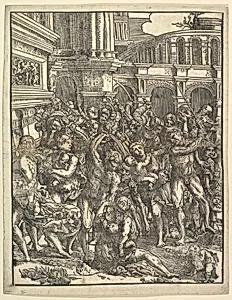
The Massacre of the Innocents (Right side) with group of male figures attacking women and children; classical buildings in the background
Medium
Woodcut
Dimensions
Block: 20 11/16 × 16 3/8 in. (52.6 × 41.6 cm) Sheet: 21 7/8 × 17 1/16 in. (55.5 × 43.4 cm) Image: 20 11/16 × 16 3/8 in. (52.6 × 41.6 cm)
Classification
Prints
Department
Drawings and Prints
Museum
Metropolitan Museum of Art, New York, NY
Credit
Harris Brisbane Dick Fund, 1925
Accession Number
25.75.77
Rights
Public Domain
Tags
Art Historical Context
Domenico Campagnola's *The Massacre of the Innocents (Right side)*, in 1517, a harrowing moment from the New Testament: King Herod's soldiers slaughtering infant boys in a futile attempt to eliminate the infant Jesus. This woodcut, the right panel of a larger composition, depicts a chaotic group of muscular male figures—many nude—brutally attacking desperate women and children amid grand classical buildings in the background. The Venetian artist's dramatic rendering evokes the Renaissance fascination with biblical narratives and antiquity, blending intense emotion with architectural grandeur. As a masterful woodcut, this print showcases Campagnola's expertise in the medium, a relief printing technique popular in early 16th-century Italy for producing bold, high-contrast images. At an impressive 20 11/16 × 16 3/8 inches, the block allowed for intricate details in figures and architecture, rivaling painting in expressiveness. Trained under Titian, Campagnola advanced woodcut artistry, often employing chiaroscuro effects to heighten drama and depth. Housed in the Metropolitan Museum of Art's Drawings and Prints department, this work highlights the era's cultural power of prints to disseminate religious stories to wide audiences. Its raw depiction of violence, maternal anguish, and heroic nudes underscores Renaissance humanism's exploration of the human form amid tragedy, inviting viewers to reflect on innocence lost.
About the Artist
Domenico Campagnola · 1500–1564
Domenico Campagnola (c. 1500–1564), a Venetian Renaissance painter, engraver, and pioneering draftsman, was born around 1500, likely in Venice to German parents, and became a child prodigy under the tutelage of his adoptive father, Giulio Campagnola. Apprenticed to Giulio around 1507 in Venice, he mastered painting, drawing, engraving, and woodcutting from the esteemed Paduan engraver, whose stipp...