
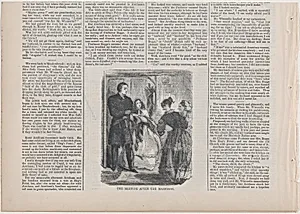
The Meeting After the Marriage (from "The Mistress of the Parsonage," in "Harper's Weekly")
February 25, 1860
Medium
Wood engraving
Dimensions
image: 4 3/8 x 3 1/2 in. (11.1 x 8.9 cm) sheet: 15 3/4 x 11 1/4 in. (40 x 28.5 cm)
Classification
Prints
Department
Drawings and Prints
Museum
Metropolitan Museum of Art, New York, NY
Credit
Harris Brisbane Dick Fund, 1928
Accession Number
28.111.1(16)
Rights
Public Domain
Tags
Art Historical Context
This wood engraving by Winslow Homer, published in *Harper’s Weekly* on February 25, 1860, captures a tender domestic moment titled *The Meeting After the Marriage*. Created as an illustration for the “The Mistress of thesonage,” the small scene (just over four inches wide) depicts a and woman in quiet conversation reflecting the popular 19th-century interest in and romantic narratives. Homer, then a young artist beginning his career as a magazine illustrator, skillfully used the demanding wood-engraving technique to convey emotion through posture and expression rather than elaborate detail. Published just before the Civil War, the print offers a glimpse into mid-Victorian American life and the growing reach of illustrated periodicals. Harper & Brothers used such images to bring literature and current events into middle-class homes, making art accessible beyond gallery walls. Homer’s economical line work and sensitive rendering of figures already hint at the observational talent that would later define his celebrated paintings and watercolors. Today in the Metropolitan Museum’s collection, this modest print reminds viewers how Homer’s early commercial assignments laid the foundation for his rise as one of America’s most important artists.
About the Artist
Winslow Homer|Harper's Weekly|Harper & Brothers · 1836–1910
Winslow Homer (1836-1910) was one of America's greatest painters and a preeminent figure in 19th-century American art. Largely self-taught, Homer began his career as a commercial illustrator and Civil War correspondent for Harper's Weekly before becoming renowned for his powerful marine subjects and landscape paintings. His mastery of both oil and watercolor, combined with his uncompromising reali...