
"The Mi'raj or The Night Flight of Muhammad on his Steed Buraq", Folio 3v from a Bustan of Sa`di
ca. 1525–35
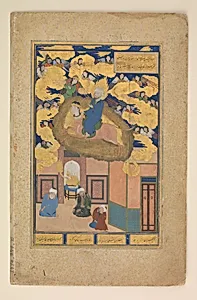
Medium
Ink, gold, and colors on paper
Dimensions
Painting: H. 7 1/2 in. (19 cm) W. 5 in. (12.7 cm) Page: H. 11 in. (27.9 cm) W. 7 1/4 in. (18.4 cm) Mat: H. 19 1/4 in. (48.9 cm) W. 14 1/4 in. (36.2 cm)
Classification
Codices
Department
Islamic Art
Museum
Metropolitan Museum of Art, New York, NY
Credit
Purchase, Louis V. Bell Fund and The Vincent Astor Foundation Gift, 1974
Accession Number
1974.294.2
Rights
Public Domain
Tags
Art Historical Context
This luminous folio captures the Mi'raj, the Prophet Muhammad’s miraculous night journey, as he rides the winged, human-faced steed Buraq across the heavens. Created around 5–35 by the artist Sultan Muhammad Nur, the painting appears in a manuscript of Saʿdi’s Bustan, a beloved collection of moral and mystical poetry. The scene draws on centuries-old Islamic traditions that celebrate this event as a moment of divine encounter and spiritual elevation. Executed in ink, gold, and delicate mineral colors on paper, the work exemplifies the refined techniques of Safavid manuscript illumination. Gold highlights the celestial realm while fine brushwork renders the mythical creature’s ornate trappings and the Prophet’s serene figure, inviting viewers to contemplate both the wondrous and the sacred. Such illustrations transformed books into portable galleries, where poetry and image together guided reflection on faith and ethics. Preserved today at the Metropolitan Museum of Art, this folio reminds us how Persian artists wove religious narrative, literary heritage, and exquisite craftsmanship into objects of enduring beauty and meaning.