
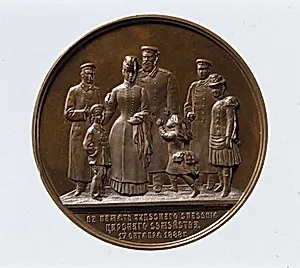
The Miraculous Rescue of Alexander III and the Imperial Family, 1888
Medium
Bronze
Dimensions
Diameter: 3 1/2 in. (8.9 cm)
Classification
Medals and Plaquettes
Culture
Russian
Department
European Sculpture and Decorative Arts
Museum
Metropolitan Museum of Art, New York, NY
Credit
Purchase, Friends of European Sculpture and Decorative Arts Gifts, 1995
Accession Number
1995.424.2
Rights
Public Domain
Tags
Art Historical Context
In 1888, Tsar Alexander III and his family narrowly escaped death in the Borki train disaster, a catastrophic derailment near Kharkov in the Russian Empire. As the train plunged off the tracks at high speed, the Tsar famously held up the collapsed roof of the imperial carriage with his immense strength, shielding his wife, children, and retinue long enough for rescuers to arrive. This bronze medal by Russian artist Avenir Grigoryevich Grilliches immortalizes that "miraculous rescue," capturing the tension and heroism in intricate relief. Measuring just 3½ inches in diameter, it features the imperial family—men, women, boys, and girls—amid the wreckage, blending portraiture with dramatic narrative. Grilliches, a skilled medalist in the late 19th-century Russian tradition, employed fine chasing and patination techniques on bronze to achieve lifelike depth and emotional intensity. Medals like this were prized commemorative objects, often circulated among elites to celebrate pivotal events and reinforce the Romanov dynasty's divine aura. Housed in the Metropolitan Museum of Art's European Sculpture and Decorative Arts department, this 1995 acquisition highlights the era's blend of technical virtuosity and patriotic fervor, offering visitors a tangible link to imperial Russia's turbulent history.