
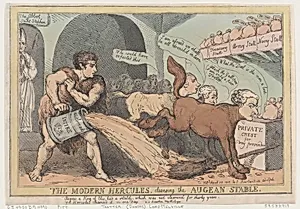
The Modern Hercules, Cleansing the Augean Stable
Medium
Hand-colored etching
Dimensions
Sheet: 9 7/16 × 13 9/16 in. (24 × 34.5 cm)
Classification
Prints
Department
Drawings and Prints
Museum
Metropolitan Museum of Art, New York, NY
Credit
The Elisha Whittelsey Collection, The Elisha Whittelsey Fund, 1959
Accession Number
59.533.919
Rights
Public Domain
Tags
Art Historical Context
Step into the witty world of early 19th-century British satire with *The Modern Hercules, Cleansing the Augean Stable*, a hand-colored etching created by renowned caricaturist Thomas Rowlandson on April 23, 1805. This lively print draws from Greek mythology, where Hercules performed the Herculean task of cleaning the filth-choked Augean stables in a single day. Here, Rowlandson casts political heavyweights William Pitt and Henry Dundas, 1st Viscount Melville, as the "modern" heroes tackling a monumental mess—likely a barbed commentary on government corruption or administrative chaos during Pitt's second ministry amid the Napoleonic Wars. Dated to a tense period when Britain grappled with war debts and scandals, particularly in naval affairs under Dundas's watch as First Lord of the Admiralty, the artwork skewers the era's power players. Pitt, the long-serving Prime Minister, and his ally Dundas are depicted in exaggerated, comical poses, highlighting Rowlandson's mastery of caricature to critique the elite. Such prints were popular pamphlets, fueling public discourse on politics and accountability. Rowlandson's hand-colored etching technique adds vibrant humor, with bold lines and vivid hues amplifying the satire's punch. Measuring about 9½ by 13½ inches, this gem from the Metropolitan Museum of Art's Elisha Whittelsey Collection exemplifies how prints democratized political commentary, blending art and activism for everyday viewers.
About the Artist
Thomas Rowlandson|William Pitt|Henry Dundas, 1st Viscount Melville · 1756–1827
Thomas Rowlandson (1757–1827) was an English artist and caricaturist whose satirical watercolors and prints captured the social life of Georgian Britain with unparalleled wit and technical mastery. Alongside James Gillray, he is recognized as one of the greatest British graphic artists, and his distinctive flowing line and keen observations have made his work integral to understanding late 18th an...