
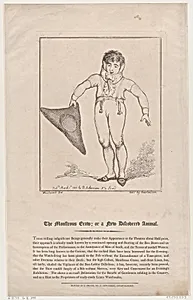
The Monstrous Craw; or a New-Discovered Animal
Medium
Etching
Dimensions
Sheet: 17 7/16 × 10 7/8 in. (44.3 × 27.7 cm) Plate: 9 7/8 × 7 13/16 in. (25.1 × 19.9 cm)
Classification
Prints
Department
Drawings and Prints
Museum
Metropolitan Museum of Art, New York, NY
Credit
The Elisha Whittelsey Collection, The Elisha Whittelsey Fund, 1959
Accession Number
59.533.823
Rights
Public Domain
Tags
Art Historical Context
Step into the whimsical world of early 19th-century British satire with *The Monstrous Craw; or New-Discovered Animal*March 1, 1802), a hand-pulled etching published by the renowned printmaker Rudolph Ackermann in London Collaboratively crafted by designer George Murgatroyd, caricaturist Thomas Rowlandson and etcher Edward Spragg, print measures about 10 by 18 inches and exemplifies the vibrant etching technique—where acid bites into a metal plate to create sharp, expressive lines perfect for humorous exaggeration. The title playfully skewers the era's flamboyant men's fashion, transforming the oversized cravat (or "craw") into a bizarre, monstrous creature devouring its wearer's head. This caricature captures the Regency dandy's obsession with elaborate neckwear, a symbol of status amid London's social whirl. Rowlandson, a master of biting wit, and his collaborators lampooned such trends through Ackermann's popular Repository of Arts, making high fashion accessible—and ridiculous—to the masses. Housed in the Metropolitan Museum of Art's Elisha Whittelsey Collection, this piece highlights the cultural power of prints as social commentary, blending artistry with everyday critique in an age when satire shaped public taste. A delightful glimpse into 1802's style excesses!
About the Artist
Rudolph Ackermann, London|George Murgatroyd Woodward|Thomas Rowlandson|Edward Spragg · 1794–1832
**Rudolph Ackermann (1764–1834)** was a pivotal Anglo-German publisher, printseller, and entrepreneur whose London-based business shaped Regency-era visual culture through innovative printmaking and illustrated publications. Born in Stollberg, Saxony, he trained as a saddler and coach-builder before moving to London around 1787. He initially worked in carriage design and related trades, later esta...