
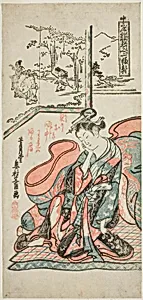
The Morning After, from "Thinking of Rising from Bed - A Set of Three (Toko banare omoi iri sanpukutsui)"
c. 1750
Medium
Color woodblock print; hosoban, benizuri-e
Dimensions
31.1 × 14.5 cm (12 × 5 3/4 in.)
Classification
woodblock print
Department
Arts of Asia
Museum
Art Institute of Chicago
Accession Number
88878
Rights
Public Domain
Art Historical Context
**The Morning After**, created by Okumura Masanobu around 1750, captures a poignant moment of languid reluctance from the series *Thinking of Rising from Bed - A Set of Three (Toko banare omoi iri sanpukutsui)*. This intimate woodblock print depicts a figure—likely a courtesan or beauty of the floating world—nestled in disheveled bedding, embodying the hazy aftermath of nocturnal pleasures. Masanobu, a pioneering ukiyo-e artist active in Edo (modern Tokyo), masterfully evoked the everyday poetry of urban life during Japan's Genroku era, where such scenes reflected the indulgent culture of pleasure districts. Printed in the hosoban format—a slender 31.1 × 14.5 cm design ideal for album pages or fans—this benizuri-e employs a limited palette of rose-red and black inks, an innovative early color technique that predated full-color nishiki-e prints. Masanobu's subtle shading and textural details mimic Western mezzotint effects, showcasing his experimental fusion of Japanese woodblock carving with imported influences, making this work a bridge in printmaking evolution. Housed in the Art Institute of Chicago's Arts of Asia collection, *The Morning After* highlights ukiyo-e's role in democratizing art for commoners. It invites visitors to ponder the universal drag of dawn after delight, a timeless slice of Edo's vibrant, hedonistic spirit.
About the Artist
Okumura Masanobu · 1686–1764
Japanese, 1686–1764