
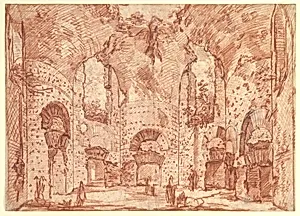
The Octagonal Room in the Small Baths at the Villa of Hadrian (Tivoli)
ca. 1777
Medium
Red chalk over black chalk or charcoal with partly ruled construction; sheet glued onto secondary paper support
Dimensions
15 1/2 x 21 3/4in. (39.4 x 55.3cm)
Classification
Drawings|Ornament & Architecture
Department
Drawings and Prints
Museum
Metropolitan Museum of Art, New York, NY
Credit
Purchase, Anonymous Gift and George and Lisa McFadden Gift, 1994
Accession Number
1994.20
Rights
Public Domain
Tags
Art Historical Context
Step into the intricate world of ancient Roman architecture through Giovanni Battista Piranesi's *The Octagonal Room in Small Baths at the Villa Hadrian (Tivoli)*, created around 1777. Piranesi, the visionary 18th-century Italian and architect, was renowned for his dramatic etchings of Roman ruins and fantastical prisons, blending meticulous documentation with imaginative flair. This drawing captures the elegant octagonal hall from Emperor Hadrian's sprawling villa complex near Tivoli, built in early 2nd century AD a retreat blending Greek, Egyptian, and Roman influences—a testament to imperial grandeur and eclecticism. Piranesi's fascination with antiquity shines here, as he meticulously rendered the room's vaulted ceiling, niches, and marble-clad walls amid the site's evocative ruins. His work fueled the neoclassical revival, inspiring architects and artists to revive classical forms. Measuring 15½ × 21¾ inches, this preparatory study likely informed his famous etched *Vedute* series, preserving Hadrian's innovative bath designs for posterity. Crafted in red chalk over black chalk or charcoal, with precise ruled lines for architectural accuracy and the sheet reinforced on secondary support, the drawing masterfully conveys depth, light, and decay. At the Metropolitan Museum of Art, it invites visitors to ponder how Piranesi bridged past and present, turning ruins into enduring poetry.
About the Artist
Giovanni Battista Piranesi · 1720–1778
Giovanni Battista Piranesi (1720–1778) was an Italian printmaker, architect, and antiquarian whose visionary etchings of Rome and imaginary prisons revolutionized architectural representation and profoundly influenced both Neoclassicism and Romanticism. Piranesi stands as one of the most important printmakers of the eighteenth century, fundamentally shaping European perceptions of ancient Rome an...