
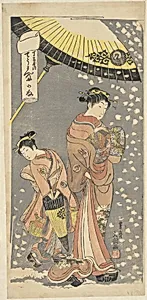
The Oiran Chōzan of Chōjiya, from the series Love Letters
ca. 1769
Medium
Woodblock print; ink and color on paper
Dimensions
Hosoe: 12 3/4 x 6 in. (32.4 x 15.2 cm)
Classification
Prints
Culture & Period
Japan · Edo period (1615–1868)
Department
Asian Art
Museum
Metropolitan Museum of Art, New York, NY
Credit
The Howard Mansfield Collection, Purchase, Rogers Fund, 1936
Accession Number
JP2412
Rights
Public Domain
Tags
Art Historical Context
In the vibrant world of Edo-period Japan (1615–1868), Ippitsusai Bunch's woodblock print *The Oiran Chōzan Chōjiya, from the series Love Letters*ca. 1769) captures the allure of a high-ranking courtes, or *oiran*, from the famed Yoshiwara pleasure district. Chzan, depicted in elegant kimono with flowing patterns and an air of poised seduction, embodies the *bijin-ga* (pictures of beautiful women) tradition central to ukiyo-e, the "pictures of the floating world" that celebrated fleeting pleasures like theater, fashion, and romance. This intimate *hosoe*-format print, measuring just 12¾ x 6 inches, was designed for personal enjoyment, reflecting the era's booming urban culture in cities like Edo (modern Tokyo). Bunchō, a master of the ukiyo-e school, excelled in dynamic compositions and subtle color gradients achieved through meticulous woodblock printing—a collaborative process where artists designed, carvers shaped blocks, and printers layered ink and pigments on paper. The *Love Letters* series likely evokes romantic exchanges between courtesans and clients, highlighting the oiran's status as cultural icons who paraded in lavish processions, blending artistry, performance, and commerce. Oiran like Chōzan symbolized refined beauty and exclusivity, far above ordinary prostitutes, and their images fueled a mass-produced art form that democratized luxury. Today, this print from The Metropolitan Museum of Art's Howard Mansfield Collection offers a window into Japan's playful yet hierarchical pleasure quarters, where women navigated power through grace and style.
About the Artist
Ippitsusai Bunchō · 1730–1820
Ippitsusai Bunchō (active c. 1765–1792) stands as one of the pivotal figures in the development of ukiyo-e actor portraiture, a artist whose innovations fundamentally transformed how kabuki actors were depicted in Japanese woodblock prints. Working during what scholars often call the 'golden age of ukiyo-e,' Bunchō, along with his contemporary Katsukawa Shunshō, revolutionized the yakusha-e (actor...