
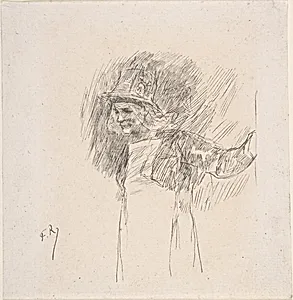
The Old Flemish Woman (La Vieille Flamande)
Medium
black ink on paper
Dimensions
sheet: 4 7/8 x 4 3/4 in. (12.4 x 12.1 cm)
Classification
Drawings
Department
Drawings and Prints
Museum
Metropolitan Museum of Art, New York, NY
Credit
Gift of Lucien Goldschmidt, 1972
Accession Number
1972.731
Rights
Public Domain
Tags
Art Historical Context
Félicien Rops, a pioneering Belgian artist of the 19th century captures the essence of everyday character in his undated drawing *The Old Flemish Woman (La Vie Flamande)*. Known for his bold Symbolist and Realist influences, Rops often explored the human figure with a satirical edge, blending intricate detail with psychological depth. This intimate portrait likely evokes the rugged spirit of Flemish folk life, portraying an elderly woman as a vivid archetype of regional identity. Rendered in black ink on paper, the work measures just 4 7/8 x 4 3/4 inches, highlighting Rops' mastery of line work in small-scale drawings. Ink allowed him to achieve dramatic contrasts and expressive textures, a technique he honed in illustrations for books and periodicals. Such drawings were prized for their immediacy, bridging fine art and caricature during the fin-de-siècle era. Now housed in the Metropolitan Museum of Art's Department of Drawings and Prints—thanks to a 1972 gift from Lucien Goldschmidt—this piece invites visitors to appreciate Rops' fascination with women as complex subjects. It stands as a testament to his ability to immortalize the overlooked, offering a window into 19th-century European portraiture.
About the Artist
Félicien Rops · 1833–1898
Félicien Rops, born Félicien Victor Joseph Rops on July 7, 1833, in Namur, Belgium, to a prosperous textile manufacturing family, displayed prodigious artistic talent from youth. The only child of Nicholas Rops and Sophie Maubile, he received private tutoring until age ten, followed by education at a Jesuit school in Namur (1843–1848), the Athénée Royal de Namur, and the Academy of Fine Arts there...