
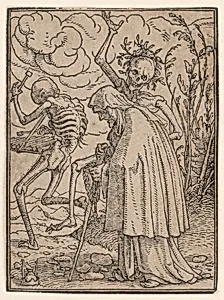
The Old Woman, from The Dance of Death
ca. 1526, published 1538
Medium
Woodcut
Dimensions
Sheet: 2 9/16 x 1 15/16 in. (6.5 x 4.9 cm)
Classification
Prints
Department
Drawings and Prints
Museum
Metropolitan Museum of Art, New York, NY
Credit
Rogers Fund, 1919
Accession Number
19.57.25
Rights
Public Domain
Tags
Art Historical Context
In Hans Holbein the Younger's iconic *Dance of Death* series, *The Old Woman* (ca. 1526, published 1538) captures grim inevitability of mortality through a masterful woodcut, meticulously cut by Hans Lützel. This tiny print (just 2 9/16 x 1 15/16 inches) belongs to a renowned set of 41 images that personify Death as a skeleton, dragging victims from every social stratum into an egalitarian dance macabre. Here, an elderly woman confronts her end, embodying the Renaissance fascination with *memento mori*—reminders that death spares no one, regardless of age or status. A staple of 16th-century European art, the *Dance of Death* motif originated in medieval frescoes and murals, evolving into affordable woodcuts during the Reformation. Holbein's crisp lines and expressive details—rendered with extraordinary precision on such a small scale—made these prints wildly popular, disseminating moral lessons on humility and piety to a broad audience via books like Simon Schumann's 1538 edition. Housed in the Metropolitan Museum of Art's Drawings and Prints department (Rogers Fund, 1919), this work showcases woodcutting's technical brilliance: Lützelburger's expert engraving allowed Holbein's dynamic compositions to shine, blending Northern Renaissance realism with stark allegory. It's a poignant window into a time when art served as both mirror and moral compass.