
The Original Sin
n.d.
Medium
Engraving on ivory laid paper
Dimensions
Image/sheet, cut within platemark: 5.3 × 7.5 cm (2 1/8 × 3 in.)
Classification
engraving
Department
Prints and Drawings
Museum
Art Institute of Chicago
Accession Number
133210
Rights
Public Domain
Art Historical Context
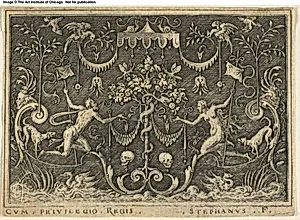
Étienne Delaune's *The Original Sin*, an engraving from the 16th century, captures biblical moment of Adam and Eve's fall from grace in the Garden of Eden. As a leading French Mannerist artist and goldsmith, Delaune (9–1592) was renowned for his intricate designs that blended Renaissance elegance with elongated forms and decorative flourish, often serving as models for jewelers and metalworkers. This undated work exemplifies his mastery in miniature scale, measuring just 5.3 × 7.5 cm, making it a portable treasure likely cherished by collectors of the era. Printed on luxurious ivory laid paper, the engraving showcases Delaune's precise intaglio technique, where fine lines incised into a copper plate hold ink to produce sharp, detailed impressions. The choice of ivory-toned paper enhances the luminous quality, evoking the ethereal garden setting. Housed in the Art Institute of Chicago's Prints and Drawings Department, this piece highlights the Renaissance boom in printmaking, which democratized art while allowing artists like Delaune to experiment with narrative depth in tiny formats. Its cultural resonance lies in Mannerism's interpretive twist on classical themes, inviting viewers to ponder temptation and humanity's origins. A gem for close contemplation, it reveals how prints bridged fine art and everyday luxury in 16th-century France.