
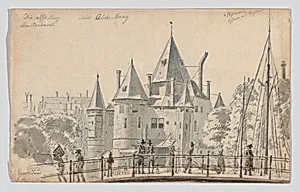
The Oude Waag in Amsterdam Seen from the North-East
1834
Medium
Graphite, gray, blue-gray and brown wash
Dimensions
Sheet: 4 1/2 × 7 3/16 in. (11.4 × 18.2 cm)
Classification
Drawings
Department
Drawings and Prints
Museum
Metropolitan Museum of Art, New York, NY
Credit
Karen B. Cohen Fund, 2014
Accession Number
2014.485.4
Rights
Public Domain
Tags
Art Historical Context
In 1834, Danish artist Martinus Rørbye captured the majestic Oude Waag, Amsterdam's historic Old Weigh House, in this intimate drawing viewed from the northeast. Rørbye, a key figure in Denmark's Golden Age of painting, was traveling through the Netherlands that year, sketching architectural gems amid the city's canals and bridges. The Oude Waag, a 15th-century Gothic structure once central to the city's bustling trade as a weighing station for goods, stands as a symbol of Amsterdam's mercantile golden age. Rendered on a modest 4½ × 7⅜-inch sheet, the work employs graphite for precise outlines and subtle gray, blue-gray, and brown washes to evoke depth, atmosphere, and the play of light on brick and water. This mixed-media technique, common in 19th-century travel sketches, allowed Rørbye to blend meticulous detail with romantic tonal effects, influenced by Dutch masters like Rembrandt whom he admired during his trip. Today, housed in The Metropolitan Museum of Art's Drawings and Prints department (Karen B. Cohen Fund, 2014), this piece offers a poignant glimpse into everyday urban life before Amsterdam's modernization, inviting us to appreciate Rørbye's eye for enduring landmarks.
About the Artist
Martinus Rørbye · 1803–1848
**Martinus Christian Wesseltoft Rørbye (1803–1848) was a Danish painter celebrated for his genre scenes, landscapes, and architectural views, emerging as a central figure in the Danish Golden Age of painting.** Born on 17 May 1803 in Drammen, Norway, to Danish parents, he moved early to Copenhagen and began studies at the Royal Danish Academy of Fine Arts in 1820. There he trained under Christian ...