
The Oval Fountain in the Gardens of the Villa d'Este, Tivoli
1760
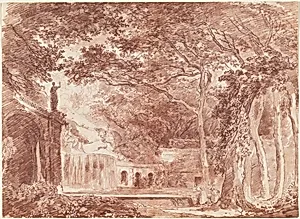
Medium
red chalk over graphite on laid paper
Dimensions
sheet: 32.7 × 45.1 cm (12 7/8 × 17 3/4 in.)
Classification
Drawing
Department
CG-E
Museum
National Gallery of Art, Washington, D.C.
Credit
Gift of Mr. and Mrs. Neil Phillips and Mr. and Mrs. Ivan Phillips, in Honor of the 50th Anniversary of the National Gallery of Art
Accession Number
1990.129.1
Rights
Public Domain
Art Historical Context
Step into the lush, imagined gardens of the Villa d'Este in Tivoli with Hubert Robert's delicate drawing *The Oval Fountain*, created around 1760. Robert, a masterful French artist often called "Robert des Ru," spent over a decade in Italy from 1754 to 1765, sketching the grandeur of ancient sites and Renaissance wonders. This work captures the iconic Oval Fountain—a centerpiece of the villa's terraced gardens, designed in the 16th century by Pirro Ligorio—evoking the playful interplay of water, architecture, and nature that defined Mannerist landscaping. Executed in red chalk over graphite on laid paper (32.7 × 45.1 cm), the piece showcases Robert's virtuoso technique. Graphite underdrawing provides precise outlines, while the warm red chalk builds subtle tonal depth and atmospheric haze, lending a sense of timeless reverie. Such drawings were prized in the 18th century as both studies for paintings and standalone treasures, reflecting the Grand Tour era when young aristocrats collected views of Italy's splendors. Today, this gift to the National Gallery of Art honors its 50th anniversary, inviting us to appreciate Robert's romantic vision of decayed elegance—a bridge between neoclassical precision and emerging Romanticism. Imagine the fountain's waters cascading amid cypress groves; Robert's hand brings that magic vividly to life.
About the Artist
Hubert Robert · 1733–1808
Hubert Robert, born on May 22, 1733, in Paris, emerged from a modest background; his father, Nicolas Robert, served the influential Choiseul family, whose patronage shaped the young artist's path. After completing his studies at the Jesuit Collège de Navarre in 1751, he entered the atelier of sculptor Michel-Ange Slodtz, who taught him design and perspective before encouraging a shift to painting....