
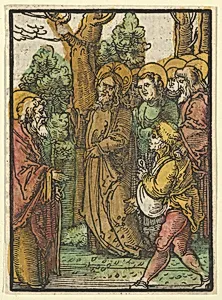
The Parable of the Sower and the Weeds, from Das Plenarium
Medium
Woodcut (hand-colored)
Dimensions
Sheet: 3 11/16 × 2 11/16 in. (9.4 × 6.8 cm)
Classification
Prints
Department
Drawings and Prints
Museum
Metropolitan Museum of Art, New York, NY
Credit
Gift of Harry G. Friedman, 1961
Accession Number
61.663.343
Rights
Public Domain
Tags
Art Historical Context
Behold *The Parable of theower and the Weeds a delicate hand-colored woodcut from 1517, created by German artist Hans Schäufelein printed by Adam Petri as part of *Das Plen*, a comprehensive liturgical book. Measuring just 3 11/16 × 2 11/16 inches, this intimate print captures Jesus teaching his disciples amid a gathered crowd of men and saints, vividly illustrating the biblical parable from Matthew 13. Schäufelein, a pupil of Albrecht Dürer and a key figure in the Northern Renaissance, masterfully employed the woodcut medium—ideal for mass-producing affordable religious illustrations during the early age of printing. This artwork reflects the cultural fervor of 1517, a pivotal year just before Martin Luther's Reformation, when printed books like *Das Plenarium* democratized scripture and liturgy for lay audiences across Europe. The hand-coloring elevates the black-line woodcut, adding vibrant life to the scene and highlighting Schäufelein's precise, expressive style influenced by late Gothic and emerging Renaissance forms. Donated to the Metropolitan Museum of Art in 1961, it exemplifies how small-scale prints bridged art and devotion, making profound parables—here, lessons on faith's growth amid trials—accessible and enduring. (198 words)
About the Artist
Hans Schäufelein|Adam Petri · 1480–1540
Hans Schäufelein (c. 1480–c. 1540) was a German painter and graphic artist of the Northern Renaissance whose career placed him at the heart of one of the most dynamic artistic environments in European history. As a young man, he entered the workshop of Albrecht Dürer in Nuremberg, an experience that proved decisive: Dürer's meticulous approach to draughtsmanship, his mastery of printmaking, and hi...