
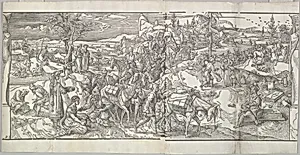
The Passage of a Caravan from the frieze Ces Moeurs et fachons de faire de Turcz (Customs and Fashions of the Turks)
Medium
Woodcut
Dimensions
Sheet: 13 11/16 × 26 7/8 in. (34.7 × 68.2 cm)
Classification
Prints
Department
Drawings and Prints
Museum
Metropolitan Museum of Art, New York, NY
Credit
Harris Brisbane Dick Fund, 1928
Accession Number
28.85.2
Rights
Public Domain
Tags
Art Historical Context
In the bustling world of 16th-century Europe, "The Passage of a Caravan" captures the exotic allure of the Ottoman Empire through the eyes of Flemish artist Pieter Coecke vanelst and his wife Mayken Verhulst Created in 1553 as part of the frieze *Ces Moeurs et Fashions de Faire de Turcz ("Customs and Fashions of the Turks"), this woodcut print a lively caravan procession with men, women, and winding through a landscape. Coecke, who traveled extensively including to Constantinople, drew from firsthand sketches to document Turkish daily life, blending observation with artistic flair. This panoramic sheet—measuring over two feet wide—exemplifies the woodcut medium's power for detailed, reproducible imagery, allowing Europeans to glimpse the "Orient" amid rising fascination with Islamic cultures during the Renaissance. As a frieze segment, it evokes a sense of continuous motion, highlighting customs like communal travel that symbolized Ottoman prosperity and mobility. Housed in the Metropolitan Museum of Art's Drawings and Prints department (acquired via the Harris Brisbane Dick Fund in 1928), the print bridges art and ethnography, offering visitors a window into cross-cultural exchange and the era's curiosity about the world beyond Europe.
About the Artist
Pieter Coecke van Aelst|Mayken Verhulst · 1502–1550
Pieter Coecke van Aelst (1502–1550) was a leading Flemish artist of the Renaissance, renowned for his multifaceted talents as a painter, sculptor, architect, and designer of tapestries, stained glass, woodcuts, and metalwork. Born in Aalst, in the Southern Netherlands (modern-day Belgium), he likely studied under Bernaert van Orley, a prominent Antwerp painter, before becoming a master in the city...