
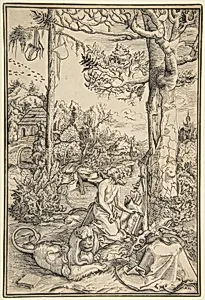
The Penitent St. Jerome
Medium
Pen and black and gray ink. Double framing line in pen and black ink, by the artist.
Dimensions
sheet: 13 9/16 x 9 3/16 in. (34.4 x 23.3 cm)
Classification
Drawings
Department
Drawings and Prints
Museum
Metropolitan Museum of Art, New York, NY
Credit
The Elisha Whittelsey Collection, The Elisha Whittelsey Fund, 2008
Accession Number
2008.505
Rights
Public Domain
Tags
Art Historical Context
In the tranquil wilderness evoked by *The Penitent St.*, a drawing from the Metropolitan Museum of Art's Drawings and Prints collection, encounter the revered 4th-century saint in his iconic pose of contemplation and repentance. Attributed to Jost Am or Lucas Cranach the—key figures in the Northern Renaissance—this 16th-century work (ca. 1539–91) captures Jerome amid trees and his faithful lion companion, symbols of his eremitic life in the Syrian desert. Cranach, renowned for his vivid religious narratives, and Amman, a prolific draftsman and engraver, both contributed to the era's fascination with devotional imagery that bridged piety and humanism. Executed in pen and black and gray ink on a modest sheet (13 9/16 x 9 3/16 in.), the piece showcases the precision of Renaissance draftsmanship. The artist's double framing line adds a deliberate structure, emphasizing the scene's introspective drama. Ink drawings like this were prized as preparatory studies or independent works, valued for their linear elegance and portability in an age when collecting sketches became a gentleman's pursuit. This artwork reflects the Reformation-era devotion to Jerome, the Bible translator whose penance inspired countless artists. Acquired through The Elisha Whittelsey Collection in 2008, it invites visitors to ponder themes of solitude and redemption, timeless amid the rustle of imagined desert winds.
About the Artist
Jost Amman|Lucas Cranach the Elder · 1539–1591
Jost Amman (1539–1591) was a Swiss-born woodcut designer, engraver, and illustrator who became one of the most prolific and influential graphic artists of sixteenth-century Germany, producing an output of extraordinary range and technical virtuosity that shaped the visual culture of the later Reformation era. Born in Zurich, Amman moved to Nuremberg around 1560, the city that had been the center o...