
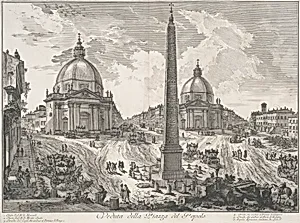
The Piazza del Popolo (Veduta della Piazza del Popolo), from "Vedute di Roma"
ca. 1750
Medium
Etching
Dimensions
image: 14 15/16 x 21 1/4 in. (38 x 54 cm)
Classification
Prints|Ornament & Architecture
Department
Drawings and Prints
Museum
Metropolitan Museum of Art, New York, NY
Credit
Harris Brisbane Dick Fund, 1937
Accession Number
37.45.3(49)
Rights
Public Domain
Tags
Art Historical Context
Step into the bustling heart of 18th-century Rome with Giovanni Battista Piranesi's etching *The Piazza del Popolo (uta della Piazza del Popolo)*, from his renowned series *Vedute di Roma* (Views of Rome), created around 1750. This view captures the grand Piazza del Popolo, a vital gateway to the Eternal City, framed by imposing twin churches, ancient obelisks, and lively roads teeming with travelers. Piranesi, a Venetian architect-turned-printmaker, immortalized Rome's architectural splendor during the Grand Tour era, when wealthy Europeans flocked to Italy for cultural enlightenment. As a master etcher, Piranesi employed intricate lines and dramatic contrasts to convey depth and scale, transforming a simple print into a vivid architectural fantasy. His vedute—topographical views—elevate real landmarks into monumental visions, blending factual accuracy with romantic exaggeration. This etching, measuring nearly 15 by 21 inches, showcases his technical prowess in rendering stone textures, shadows, and bustling urban life, making it a cornerstone of 18th-century printmaking. Housed in the Metropolitan Museum of Art's Drawings and Prints department, this work from the Harris Brisbane Dick Fund highlights Rome's enduring allure. It not only documents a pivotal public square but also fueled the neoclassical revival, inspiring generations to marvel at antiquity's legacy.
About the Artist
Giovanni Battista Piranesi · 1720–1778
Giovanni Battista Piranesi (1720–1778) was an Italian printmaker, architect, and antiquarian whose visionary etchings of Rome and imaginary prisons revolutionized architectural representation and profoundly influenced both Neoclassicism and Romanticism. Piranesi stands as one of the most important printmakers of the eighteenth century, fundamentally shaping European perceptions of ancient Rome an...