
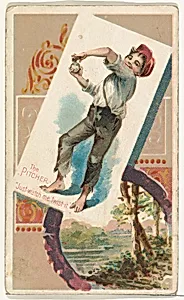
The Pitcher, "Just watch me twist it," from the Terrors of America set (N136) issued by Duke Sons & Co. to promote Honest Long Cut Tobacco
Medium
Commercial color lithograph
Dimensions
Sheet: 2 3/4 x 1 1/2 in. (7 x 3.8 cm)
Classification
Prints|Ephemera
Department
Drawings and Prints
Museum
Metropolitan Museum of Art, New York, NY
Credit
The Jefferson R. Burdick Collection, Gift of Jefferson R. Burdick
Accession Number
63.350.207.136.1
Rights
Public Domain
Tags
Art Historical Context
In the late 1880s, American tobacco companies like W. Duke, Sons & Co. revolutionized marketing with colorful collectible cards tucked into cigarette packs. This tiny chromolithograph, *The Pitcher, "Just watch me twist it* from the "Terrors of America" (N136), promotes Honest Long Cut Tobacco. Produced by Knapp & Company, it captures a cheeky young boy mid-pitch, his boastful caption evoking the spirited bravado of baseball-crazed kids. At just 2¾ x 1½ inches, these ephemera were designed for easy trading and hoarding, sparking a collecting craze among boys nationwide. Chromolithography, the era's cutting-edge printing technique, brought vivid colors and sharp details to mass-produced ads, blending commercial savvy with folkloric charm. The "Terrors" series celebrated mischievous lads in everyday American pursuits, reflecting baseball's explosive rise as a cultural phenomenon during the sport's professionalization. This card, part of The Metropolitan Museum of Art's Jefferson R. Burdick Collection, offers a window into Gilded Age youth culture—rowdy, competitive, and endlessly entertaining. Today, it reminds us how everyday objects fueled nostalgia and fandom, turning a simple tobacco insert into a treasured artifact of 19th-century Americana.
About the Artist
W. Duke, Sons & Co.|Knapp & Company · 1870–1920
**W. Duke, Sons & Co.: Pioneers of Chromolithographic Trade Card Art** W. Duke, Sons & Co., an American tobacco manufacturer, emerged from the entrepreneurial vision of Washington Duke (1820–1905) and his sons in Durham, North Carolina. After the Civil War, Washington abandoned farming in 1874 to join his eldest son, Brodie L. Duke, in the burgeoning tobacco trade, establishing a factory that for...