
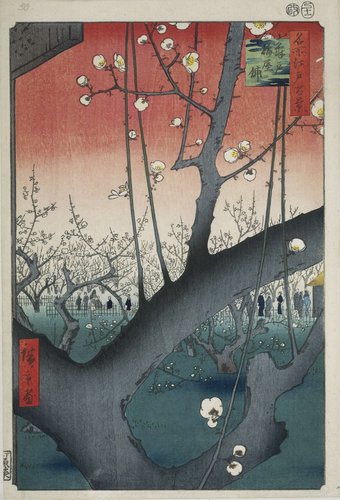
The Plum Garden at Kameido Shrine
Medium
nishiki-e
Dimensions
364; 244
Rights
Public Domain
About this artwork
Aankoop met steun van de Vereniging Rembrandt en het Ministerie van Onderwijs, Kunsten en Wetenschappen
Art Historical Context
**The Plum Garden at Kido Shrine** (1857) is a stunning *nishiki-e* woodblock by Utagawa Hiroige I, one of Japan's greatest masters of *ukiyo-e*—the "pictures of the floating world" that celebrated everyday beauty and transience. Measuring 364 × 244 mm, this *ōban*-sized work captures the serene plum garden at Kameido Tenjin Shrine Edo (modern-day Tokyo), likely during its famed spring bloom. Hiroshige's delicate composition invites viewers into a moment of quiet splendor, where blossoming branches frame distant structures under a soft sky. Created as part of Hiroshige's monumental series *One Hundred Famous Views of Edo*, this print exemplifies his genius for atmospheric landscapes. Produced amid Japan's Edo period (1603–1868), it reflects the era's fascination with seasonal poetry in visual form, blending realism with poetic evocation. *Nishiki-e* technique—using intricate woodblocks for vibrant, layered colors like delicate pinks and lush greens—brought unprecedented depth and luminosity, making these affordable prints wildly popular among all classes. Culturally, the image evokes renewal and the shrine's dedication to scholarship and warding off calamity, with plum blossoms symbolizing perseverance. Acquired with support from the Vereniging Rembrandt and the Dutch Ministry of Education, Arts and Sciences, it connects Japanese artistry to global appreciation, reminding us of nature's enduring poetry.