
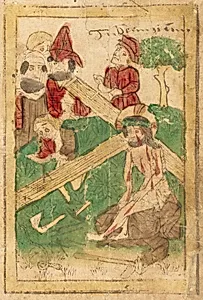
The Preparation for the Crucifixion
c. 1470
Medium
woodcut in brown, hand-colored in red lake, green, brown, and yellow
Classification
Department
CG-E
Museum
National Gallery of Art, Washington, D.C.
Credit
Rosenwald Collection
Accession Number
1943.3.518
Rights
Public Domain
Art Historical Context
*The Preparation for the Crucifix*, a captivating woodcut from around 1470 by an anonymous German artist of the 15th century, offers a poignant glimpse into late medieval devotion. This print depicts key moments from Christ's Passion—likely the mocking of Jesus, the preparation of the cross, and soldiers at work—rendered with dramatic intensity typical of Northern European religious art. Housed in the National Gallery of Art'swald Collection (Department CG-E), it exemplifies the era's fervor for visualizing sacred narratives to inspire prayer and reflection among the faithful. Crafted as a brown woodcut and meticulously hand-colored with red lake, green, brown, and yellow pigments, the work highlights the revolutionary technique of printmaking in 15th-century Germany. Woodcuts allowed for affordable mass production of images, bridging the gap between illuminated manuscripts and the coming age of engraving masters like Martin Schongauer. The vibrant hand-coloring, applied post-printing, elevated these prints from humble devotional aids to cherished treasures, mimicking the opulence of panel paintings while making piety accessible to all. This piece underscores the cultural role of prints in pre-Reformation Europe, where such images fueled personal spirituality amid growing literacy and urban piety. Its survival speaks to the enduring power of these early graphic arts, inviting us to ponder the human drama of sacrifice through a craftsman's reverent lens.
About the Artist
German 15th Century · 1400–1500
**German 15th Century** The designation "German 15th Century" encompasses a collective of anonymous artists active in the late medieval and early Renaissance periods in Germany, primarily known through their contributions to early printmaking and panel painting. These creators emerged during a transformative era when woodcuts and engravings began democratizing religious imagery, bridging the Goth...