
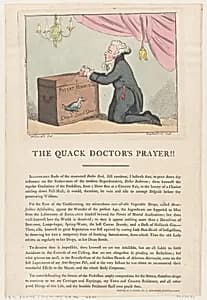
The Quack Doctor's Prayer!!
Medium
Hand-colored etching
Dimensions
Sheet: 17 7/16 × 11 3/4 in. (44.3 × 29.8 cm) Plate: 7 7/8 × 9 15/16 in. (20 × 25.2 cm)
Classification
Prints
Department
Drawings and Prints
Museum
Metropolitan Museum of Art, New York, NY
Credit
The Elisha Whittelsey Collection, The Elisha Whittelsey Fund, 1959
Accession Number
59.533.811
Rights
Public Domain
Tags
Art Historical Context
Created in 1801 by the celebrated caricaturist Thomas Rowlandson in collaboration with George Murgatroyd Woodward and publisher Edward Spragg, *The Quack Doctor's Prayer!!* is a hand-colored etching that captures the lively spirit of British satirical printmaking at the turn of the nineteenth century. Rowlandson’s distinctive style—bold lines, exaggerated expressions, and sharp social observation—made him one of the most popular artists of his day, with works widely circulated among all classes of society. The print’s title and imagery poke fun at the era’s abundance of fraudulent medical practitioners, a common target of caricature. Through witty visual puns involving ducks and men, it highlights the absurdity and danger of “quack” remedies while reflecting broader anxieties about health, trust, and authority in Georgian England. Hand-colored etchings like this one were affordable and colorful, allowing satire to reach a wide audience beyond gallery walls. Now part of the Metropolitan Museum of Art’s Elisha Whittelsey Collection, the work offers today’s visitors a delightful window into early nineteenth-century humor and the enduring power of prints to comment on everyday life.
About the Artist
Thomas Rowlandson|Edward Spragg|George Murgatroyd Woodward · 1756–1827
Thomas Rowlandson (1757–1827) was an English artist and caricaturist whose satirical watercolors and prints captured the social life of Georgian Britain with unparalleled wit and technical mastery. Alongside James Gillray, he is recognized as one of the greatest British graphic artists, and his distinctive flowing line and keen observations have made his work integral to understanding late 18th an...