
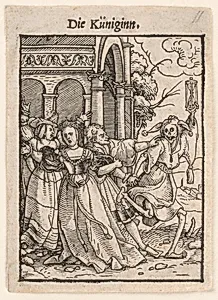
The Queen, from The Dance of Death
ca. 1526, published 1538
Medium
Woodcut
Dimensions
sheet: 2 15/16 x 2 1/8 in. (7.4 x 5.4 cm)
Classification
Prints
Department
Drawings and Prints
Museum
Metropolitan Museum of Art, New York, NY
Credit
Rogers Fund, 1919
Accession Number
19.57.11
Rights
Public Domain
Tags
Art Historical Context
Hans Holbein the Younger designed this woodcut, *The Queen*, around 1526 as part of his celebrated *Dance of Death* series, later cut by Hans Lützelburger and published in 8. Created during the turbulent years of the Reformation, the print captures the era’s preoccupation with mortality amid recurring plagues and social upheaval. In the image, a crowned queen stands gracefully while a skeletal figure approaches with an hourglass, underscoring that even royalty cannot escape death’s inevitable summons. The small woodcut format—measuring just under three inches—allowed these powerful images to circulate widely through printed books, reaching audiences far beyond the elite. Holbein’s elegant line work and balanced composition heighten the contrast between the queen’s worldly splendor and the stark, universal presence of death. Part of a larger sequence depicting figures from every rank of society, the series blends moral instruction with sharp social observation. Today, impressions like this one in the Metropolitan Museum of Art’s collection continue to remind viewers of life’s transience while showcasing the expressive potential of early printmaking.