
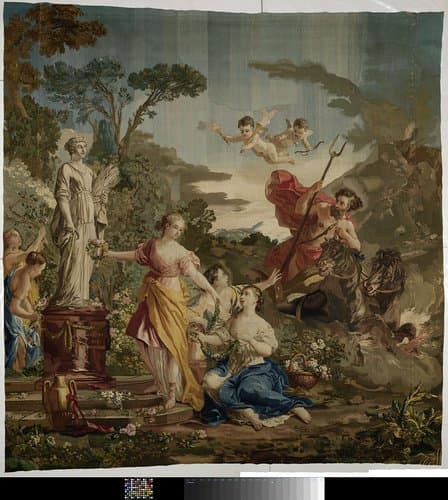
The Rape of Proserpina
Medium
tapestry
Dimensions
325; 304
Rights
Public Domain
About this artwork
opschrift, op de sokkel: Griekse tekst
Art Historical Context
Behold *The Rape of Proserpina*, a magnificent 1757 tapestry woven by the esteemed Manufacture Royale des Gobelins, France's royal tapestry workshop founded in 1663. Measuring an imposing 325 cm high by 304 cm wide, this monumental piece captures the dramatic myth from Ovid's *Metamorphoses*, where Pluto, god of the underworld, abducts the innocent Proserpina, daughter of Ceres. The scene pulses with dynamic energy, frozen in a moment of mythological turmoil, rendered in lush wool and silk threads that evoke the opulence of Louis XV's court. Crafted during the height of the Rococo era, Gobelins tapestries like this one were technical marvels of haute lisse (high-warp) weaving, where skilled artisans translated paintings into seamless textile masterpieces on upright looms. A Greek inscription on the pedestal—*opschrift, op de sokkel: Griekse tekst*—adds a layer of classical authenticity, linking the work directly to ancient sources and underscoring the 18th-century fascination with Greco-Roman antiquity. These tapestries, often commissioned for Versailles or as diplomatic gifts, symbolized French artistic supremacy and cultural refinement. Today, *The Rape of Proserpina* stands as a testament to the Gobelins' enduring legacy, blending storytelling, luxury, and craftsmanship in a single, sumptuous hanging.
About the Artist
Manufacture Royale des Gobelins
The Manufacture Royale des Gobelins, a cornerstone of French decorative arts, originated in the mid-15th century as a dyeing workshop established by the Gobelin family along the Bièvre River in Paris's Faubourg Saint-Marcel. Renowned for their scarlet dye, the Gobelins supplied the foundation for what became Europe's premier tapestry factory. In 1601, King Henry IV rented the site to Flemish weave...