
The Rhinoceros "Miss Clara"
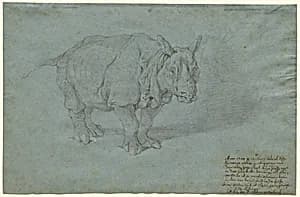
Medium
black chalk heightened with white chalk on blue laid paper, indented for transfer
Dimensions
sheet: 28.6 x 43.8 cm (11 1/4 x 17 1/4 in.)
Classification
Drawing
Department
CG-E
Museum
National Gallery of Art, Washington, D.C.
Credit
Wolfgang Ratjen Collection, Patrons' Permanent Fund
Accession Number
2007.111.29
Rights
Public Domain
Art Historical Context
**The Rhinoceros " Clara"** *Johann Elias Ridinger, 8* Black chalk heightened with white chalk on blue paper, indented for transfer sheet: 28.6 x 43.8 cm (11 1/4 x 17 1/4 in.) Step into the wonder of 18th-century with Johann Elias Ridinger's captivating drawing of "Miss Clara," the real-life rhinoceros who became a sensation across the continent. In 1748, Ridinger, a masterful German artist renowned for his dynamic depictions of animals in the Baroque tradition, captured this exotic creature on blue laid paper. Clara, shipped from India to Rotterdam in 1741, toured cities like London and Paris, drawing crowds of aristocrats and commoners alike—think of her as the era's superstar celebrity animal, inspiring poems, porcelain figurines, and even operas. Ridinger's technique shines here: black chalk forms the rhino's robust form and textured hide, heightened with white chalk for dramatic light and shadow, evoking volume and life. The indentations along the contours reveal its purpose as a transfer drawing, likely preparatory for one of Ridinger's famed engravings, allowing precise reproduction. This meticulous process underscores his role in popularizing scientific yet artistic studies of wildlife during the Enlightenment, blending natural history with aesthetic appeal. Housed in the National Gallery of Art's Wolfgang Ratjen Collection, this work invites us to marvel at how a single beast bridged curiosity, commerce, and art, reminding visitors of humanity's enduring fascination with the unknown.
About the Artist
Johann Elias Ridinger · 1698–1767
Johann Elias Ridinger (1698–1767) was born in Ulm into an artistic family, the son of scribe and artist Johann Daniel Ridinger and Regina Catharina Miller. He received his initial training in Ulm under the painter Christoph Resch, who instructed him in perspective, geometry, and architecture while assigning preparatory tasks like painting wax models. Around 1713, Ridinger moved to Augsburg, where ...