
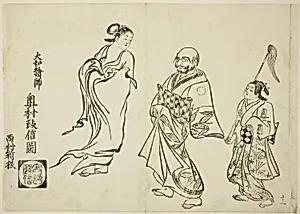
The Roles Reversed, no. 12 from a series of 12 prints
c. 1708
Medium
Woodblock print; oban, sumizuri-e
Dimensions
26.8 × 37.9 cm (10 9/16 × 14 15/16 in.)
Classification
woodblock print
Department
Arts of Asia
Museum
Art Institute of Chicago
Accession Number
19543
Rights
Public Domain
Art Historical Context
Okumura Masanobu's *The Roles Reversed, no. 12* (c. 1708) is a captivating woodblock print from a series of 12, showcasing the playful spirit of early Edo-period Japan. Printed in the oban format—measuring about 27 × 38 cm—this sumizuri-e (ink-printed picture) employs bold black lines on white paper, a technique that predates the vibrant multicolored ukiyo-e prints for which Japan later became famous. Masanobu a pioneering artist and publisher active in Tokyo (then Edo), helped popularize single-sheet prints affordable to the rising merchant class. The title hints at whimsical role reversals, a recurring motif in ukiyo-e that blurred gender and social boundaries for humor and subtle commentary on urban life. As no. 12 in the series, it likely concludes a narrative arc of gender-bending scenes, reflecting the era's fascination with kabuki theater and pleasure districts. Sumizuri-e's stark contrasts allowed for intricate details and dynamic compositions, making complex scenes accessible and collectible. This print exemplifies the artistic innovations of the Genroku era (late 17th–early 18th century), bridging traditional book illustrations to the mass-produced art that defined ukiyo-e. Housed in the Art Institute of Chicago's Arts of Asia collection, it invites us to ponder timeless themes of identity and inversion through Masanobu's masterful linework.
About the Artist
Okumura Masanobu · 1686–1764
Japanese, 1686–1764