
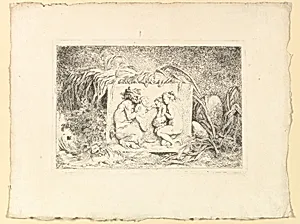
The Satyr's Family
Medium
Etching
Dimensions
Sheet: 9 1/4 in. × 12 in. (23.5 × 30.5 cm) Plate: 5 11/16 × 8 3/8 in. (14.4 × 21.3 cm) Image: 5 1/4 in. × 8 in. (13.3 × 20.3 cm)
Classification
Prints
Department
Drawings and Prints
Museum
Metropolitan Museum of Art, New York, NY
Credit
The Elisha Whittelsey Collection, The Elisha Whittelsey Fund, 1996
Accession Number
1996.328.2
Rights
Public Domain
Tags
Art Historical Context
Jean Honoré Fragonard’s *The Satyr’s Family* (1763) is a delightful etching that captures the playful spirit of 18th-century French Rococo art. In this intimate scene, a satyr—those mischievous, half-human, half-goat figures from Greek mythology—tends to his family amid female nudes and frolicking infants. Fragonard, a master of exuberant, sensual imagery, infuses the composition with whimsical energy, blending domestic tenderness with erotic undertones typical of the era’s lighthearted escapism. Created during the height of the Rococo movement, which favored ornate decoration and fantasy over the grandeur of Baroque art, this print reflects the indulgent tastes of French aristocracy on the eve of the Revolution. Etching, Fragonard’s chosen medium here, allowed for intricate, fluid lines etched into a metal plate with acid, enabling affordable reproduction of his lively sketches. The modest plate size (5 11/16 × 8 3/8 in.) made it ideal for collectors’ albums, showcasing his virtuosic draftsmanship. Housed in the Metropolitan Museum of Art’s Drawings and Prints department as part of The Elisha Whittelsey Collection, this work exemplifies Fragonard’s rare foray into printmaking, offering a window into his boundless imagination and the cultural fascination with mythological revelry. Visitors will appreciate its charm as a cheeky celebration of nature’s joys.
About the Artist
Jean Honoré Fragonard · 1732–1806
Jean-Honoré Fragonard (1732-1806) was a French painter and printmaker whose late Rococo manner was distinguished by remarkable facility, exuberance, and hedonism. Born in Grasse, he moved to Paris where he trained under Jean-Baptiste Chardin and François Boucher, winning the prestigious Prix de Rome in 1752. After studying in Italy alongside Hubert Robert, Fragonard returned to Paris in 1761 to fi...