
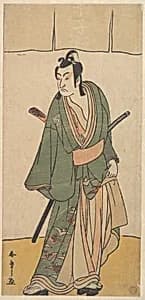
The Second Ichikawa Monnosuke in the role of Soga no Juro Sukenari
2nd month, 1785
Medium
Woodblock print (nishiki-e); ink and color on paper
Dimensions
10 31/32 x 5 1/2 in. (27.9 x 14 cm)
Classification
Prints
Culture & Period
Japan · Edo period (1615–1868)
Department
Asian Art
Museum
Metropolitan Museum of Art, New York, NY
Credit
Rogers Fund, 1914
Accession Number
JP126
Rights
Public Domain
Tags
Art Historical Context
Katsukawa Shunshō *The Second Ichikawa Monnosuke in the role of Soga no Juro Sukari* (1785) is a striking woodblock print capturing a kabuki actor in a pivotal dramatic pose. The Second Ichikawa Monnos embodies Soga no Jūrō Sukenari, one of the vengeful Soga brothers a beloved Japanese tale of filial loyalty and revenge—a staple Edo-period theater that enthralled audiences with its intense swordplay and moral drama. Shunshō, a master of the ukiyo-e ("pictures of the floating world") school, specialized in yakusha-e, or actor portraits, bringing performers to life with remarkable realism and expressiveness. This nishiki-e, or "bade picture," exemplifies the late 18th-century breakthrough in full-color woodblock printing. Multiple carved woodblocks layered ink and pigments on paper to create vibrant hues and fine details, from the gleam of the sword to the intricate folds of the costume. At just 10 31/32 x 5 1/2 inches, its compact hosoban format made it affordable and collectible, reflecting theater's central role in urban Edo life. Housed in the Metropolitan Museum of Art's Asian Art department, this print offers a vivid glimpse into Japan's Edo period (1615–1868), where art and performance intertwined to celebrate heroism and human emotion. Shunshō's work not only immortalized stars like Monnosuke but also elevated printmaking to high art.
About the Artist
Katsukawa Shunshō 勝川春章 (Japanese) · 1726 –1792
Japanese, 1726–1792