
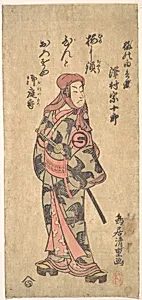
The Second Sawamura Sojuro in the Role of Ume no Yoshibei
2nd month, 1763
Medium
Woodblock print; ink and color on paper
Dimensions
11 7/8 x 5 7/16 in. (30.2 x 13.8 cm)
Classification
Prints
Culture & Period
Japan · Edo period (1615–1868)
Department
Asian Art
Museum
Metropolitan Museum of Art, New York, NY
Credit
Purchase, Joseph Pulitzer Bequest, 1918
Accession Number
JP467
Rights
Public Domain
Tags
Art Historical Context
Torii Kiyoshige's *The Second Sawamura Soj in the Role of Ume no Yosei* (1763) is a captivating woodblock print from Japan's Edo period (16151868), showcasing the famed kabuki actor Sawamura Sojuro II in a dynamic theatrical pose. This yakusha-e, or actor portrait, belongs to the ukiyo-e tradition—"pictures of the floating world"—that celebrated the era's vibrant urban culture, particularly the booming kabuki theater scene in Edo (modern Tokyo). At just 11 7/8 x 5 7/16 inches, these intimate prints were designed for everyday fans, making celebrity culture accessible beyond the theater. Kiyoshige, a master of the Torii school, pioneered bold, expressive styles in actor prints with stark outlines, vivid colors, and exaggerated features to convey emotion and movement. Printed with ink and color on paper using multiple carved woodblocks—one for the outline, others layered for hues like reds and blues—this technique allowed affordable mass production, fueling ukiyo-e's popularity. The print's cultural significance lies in immortalizing kabuki stars like Sojuro II, whose performances drew massive crowds and blurred lines between art, entertainment, and fandom. Today, housed in the Metropolitan Museum of Art's Asian Art department (Purchase, Joseph Pulitzer Bequest, 1918), it offers a window into Edo Japan's theatrical obsession, where actors were idols akin to modern celebrities.