
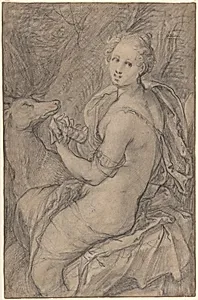
The Sense of Hearing; verso: light sketch of a woman's head and an arm
late 16th–early 17th century
Medium
Black chalk, heightened with white chalk, stumped; traces of brown and yellow chalks
Dimensions
12 3/8 x 8 1/16 in. (31.4 x 20.4 cm)
Classification
Drawings
Department
Drawings and Prints
Museum
Metropolitan Museum of Art, New York, NY
Credit
Purchase, Lila Acheson Wallace and Harvey Salzman Gifts, 1994
Accession Number
1994.87
Rights
Public Domain
Tags
Art Historical Context
Hendrick Goltzius’s *The Sense of Hearing* captures one of the five allegorical senses through an elegant female figure accompanied by deer, rendered in the late sixteenth and early seventeenth centuries. As a leading Northern Mannerist draftsman and printmaker working in Haarlem, Goltzius frequently explored sensory themes that blended classical symbolism with keen observation of the natural world. The presence of the deer, animals celebrated for their acute hearing, subtly reinforces the subject while showcasing the artist’s ability to merge human grace with animal vitality. Executed in black chalk heightened with white chalk and delicately stumped, the drawing demonstrates Goltzius’s masterful control of light and texture. This technique allowed him to create soft, luminous modeling that gives the forms a sculptural quality, while traces of colored chalk add subtle warmth. The verso’s faint sketches of a woman’s head and arm reveal the artist’s working process, offering visitors a glimpse into how such finished studies evolved from quick notations. Acquired by the Metropolitan Museum in 1994, this sheet exemplifies the refined draftsmanship prized during the period and highlights Goltzius’s enduring influence on European drawing traditions.
About the Artist
Hendrick Goltzius · 1558–1617
Hendrick Goltzius (1558–1617) was the most celebrated engraver of the Northern Renaissance and a pivotal figure in Dutch Mannerism. Born near the German-Dutch border, Goltzius transformed printmaking into a virtuoso art form through his revolutionary 'swelling line' technique, where the burin was manipulated to create lines of varying thickness that produced unprecedented tonal effects and three-d...