
The Shrine of Benten on Chikubushima Island
1821
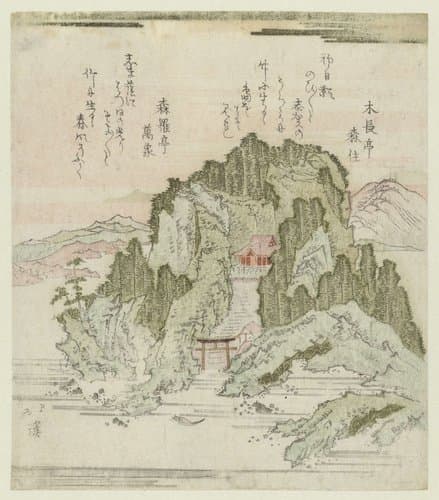
Medium
nishikie, with metallic pigments and blindprinting
Dimensions
182; 208
Rights
Public Domain
About this artwork
height 208 mm x width 182 mm
Art Historical Context
**The Shrine of Benten on Chikub Island** (1821) by Totoya Hokkei captures a serene moment at one of Japan's most evocative sacred sites. Hokkei, a prominent ukiyo-e artist and pupil of the legendary Katsushika Hokusai, created this intimate woodblock print during the late Edo period, when depictions of famous views (meisho-e) were wildly popular. The tiny format—208 mm high by 182 mm wide—suggests it was designed for personal appreciation, perhaps tucked into a collector's album. The subject is Chikubushima Island in Lake Biwa, home to a historic shrine dedicated to Benzaiten, the goddess of music, arts, and fortune. These prints often romanticized such pilgrimage spots, blending spirituality with natural beauty to evoke wanderlust among urban dwellers in Edo (modern Tokyo). Hokkei's composition likely highlights the island's misty allure and architectural elegance, inviting viewers to imagine a peaceful boat journey across the water. Rendered in nishikie—or "brocade print"—technique, the work dazzles with vibrant colors layered through woodblock printing. Metallic pigments add a luxurious shimmer, mimicking gold leaf, while blindprinting (gauffrage) introduces subtle embossed textures for depth without ink. This innovative use of effects elevated ukiyo-e from mere illustration to tactile art, showcasing the era's technical mastery and cultural reverence for beauty in the everyday divine.
About the Artist
Totoya Hokkei · 1780–1850
Totoya Hokkei (魚屋 北渓, 1780–1850), born Iwakubo Tatsuyuki in Edo (modern Tokyo), began his life as a humble fishmonger in the Yotsuya Samegahashi district, a trade reflected in his art name "Totoya," meaning fish shop. He transitioned to art through rigorous training, first studying under Kanō Yōsen'in Korenobu, head of the Kobikichō branch of the prestigious Kanō school, where he honed landscape p...