
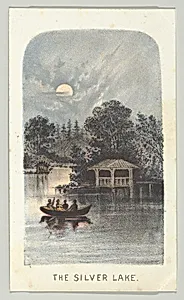
The Silver Lake, from the series, Views in Central Park, New York, Part 2
Medium
Color lithograph
Dimensions
Sheet: 4 in. × 2 3/8 in. (10.2 × 6.1 cm)
Classification
Prints|Ephemera
Department
Drawings and Prints
Museum
Metropolitan Museum of Art, New York, NY
Credit
The Jefferson R. Burdick Collection, Gift of Jefferson R. Burdick, 1947
Accession Number
47.91.25(35)
Rights
Public Domain
Tags
Art Historical Context
Step into the tranquil glow of *The Silver Lake*, a charming color lithograph from Louis Prang & Co.'s series *Views in Central Park, York, Part 2* (1864). This petite print (just 4 × 2⅜ inches) captures a moonlit scene on Silver Lake, with gentle boats gliding across shimmering waters under a starry sky. Produced shortly after Central Park's 1858 opening, it the park's early allure as a verdant escape amid New York City's rapid growth. Louis Prang & Co., pioneers of chromolithography—the era's breakthrough for vibrant, affordable color printing—excelled at reproducing scenic views like this for middle-class homes. Their technique layered colors via multiple lithographic stones, mimicking paintings with remarkable fidelity and making art accessible beyond elite collectors. This ephemera-style print, part of a collectible series, reflects 19th-century fascination with romantic landscapes and urban nature. Housed in the Metropolitan Museum of Art's Jefferson R. Burdick Collection, *The Silver Lake* highlights how such prints democratized beauty, turning a lakeside reverie into cherished souvenirs of America's burgeoning public parks. A window to Gilded Age leisure, it invites us to savor Central Park's timeless serenity.
About the Artist
Louis Prang & Co. · 1800–1950
Louis Prang & Co. was the Boston printing firm that introduced the Christmas card to the American public and elevated chromolithography to the level of a serious art form. Its founder, Louis Prang (1824–1909), was born in Breslau, Prussia (now Wrocław, Poland), where he trained as a cloth printer and dyer. After participating in revolutionary activity against the Prussian government, he fled first...