
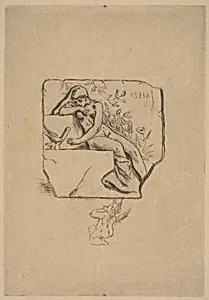
The Sparrow of Lesbie (Le moineau de Lesbie)
1826 to 1850
Medium
etching
Classification
Department
CG-E
Museum
National Gallery of Art, Washington, D.C.
Credit
Rosenwald Collection
Accession Number
1951.10.398
Rights
Public Domain
Art Historical Context
Félicien Rops, a Belgian renowned for his provocative etchings blending eroticism, symbolism, and the macabre, created *The Sparrow of LesbieLe moineau de Lesbie)* around 1826–1850. This intimate print, housed in the National Gallery of Art's Rosenwald CollectionDepartment CG-E), draws its title from the ancient Roman poet Catullus's famous verses about Lesbia's cherished sparrow—a symbol of fleeting love, innocence, and loss. Rops, active in the mid-19th century Parisian avant-garde, often infused classical motifs with his signature decadent flair, reflecting the era's fascination with sensuality and decay. As an etching, the work showcases Rops's mastery of intaglio printing, where acid bites into a metal plate to create sharp, expressive lines capable of conveying delicate textures and emotional depth. This technique allowed for editioned prints that democratized art, making Rops's bold visions accessible beyond elite patrons. Though small in scale, the piece exemplifies his early explorations in printmaking, bridging Romanticism and emerging Symbolism. Visitors to the National Gallery will appreciate how *The Sparrow of Lesbie* captures a poignant intersection of antiquity and 19th-century psyche, inviting reflection on love's fragility through Rops's unflinching gaze. A gem of the print collection, it highlights etching's enduring power to etch emotions into history.
About the Artist
Félicien Rops · 1833–1898
Félicien Rops, born Félicien Victor Joseph Rops on July 7, 1833, in Namur, Belgium, to a prosperous textile manufacturing family, displayed prodigious artistic talent from youth. The only child of Nicholas Rops and Sophie Maubile, he received private tutoring until age ten, followed by education at a Jesuit school in Namur (1843–1848), the Athénée Royal de Namur, and the Academy of Fine Arts there...