
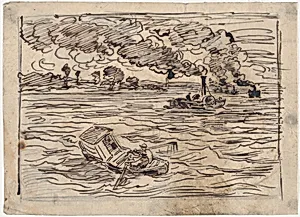
The Steamboats or Watch Out for the Steamers
Medium
Pen and ink on tracing paper, redrawn in graphite on verso
Dimensions
Sheet: 5 1/8 × 7 5/16 in. (13 × 18.6 cm)
Classification
Drawings
Department
Drawings and Prints
Museum
Metropolitan Museum of Art, New York, NY
Credit
Purchase, The Elisha Whittelsey Collection, The Elisha Whittelsey Fund and PECO Foundation Gift, 2018
Accession Number
2018.11.14
Rights
Public Domain
Tags
Art Historical Context
Charles-François Daubigny, leading figure in the Barbizon school of landscape painters, captured the serene yet evolving riverscapes of France in this lively 1862 drawing, *The Steamboats or Watch Out the Steamers*. Rendered in pen and ink on tracing paper a graphite redrawing on the verso—this intimate sketch (just over 5 by 7 inches) depictsamboats navigating a bustling waterway, likely the Seine. The playful title hints at the era's growing tension between traditional river life and industrial progress, as steam-powered vessels began dominating France's waterways in the mid-19th century. Daubigny's technique here reveals his preparatory process: tracing paper allowed him to refine compositions for larger oil paintings, a method that emphasized fluid lines and atmospheric effects. His loose, expressive pen strokes foreshadow Impressionist interests in light, movement, and everyday scenes, bridging Romanticism and modernism. Often painting *en plein air* from his studio boat, Daubigny infused such works with a sense of immediacy. Acquired by the Metropolitan Museum of Art in 2018, this drawing offers a rare glimpse into the artist's sketchbook world, highlighting how he documented the Industrial Revolution's ripple through rural France—where steamboats symbolized both opportunity and disruption. A charming window into 19th-century innovation!
About the Artist
Charles-François Daubigny · 1817–1878
Charles-François Daubigny was born on February 15, 1817, in Paris into a family of artists, with his father, Edmé-François Daubigny, a classical landscape painter, and his uncle, Pierre Daubigny, a miniaturist, providing his initial artistic training. He further studied under Jean-Victor Bertin, Jacques Raymond Brascassat, and Paul Delaroche at the École des Beaux-Arts, though he quickly moved bey...