
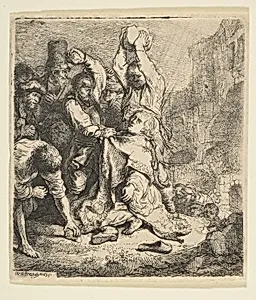
The Stoning of St. Stephen
Medium
Etching
Classification
Prints
Department
Drawings and Prints
Museum
Metropolitan Museum of Art, New York, NY
Credit
Gift of Bert Freidus, 1979
Accession Number
1979.565
Rights
Public Domain
Tags
Art Historical Context
Rembrandt van Rijn's *The Stoning of St Stephen* (1635) captures a pivotal biblical moment from the Acts of the Apostles, depicting the martyrdom of the first Christian saint. As stones rain down on the kneeling Stephen, who gazes heavenward in visionary ecstasy, the scene pulses with dramatic tension. Created early in Rembrandt's career, when he was in his late 20s and establishing himself in Amsterdam, this etching reflects the young artist's fascination with light, shadow, and human emotion, hallmarks of the Dutch Baroque style. Masterfully executed in etching—a printmaking technique where acid bites into a metal plate—Rembrandt innovated with intricate burrs and deep inking to achieve velvety textures and chiaroscuro effects. The foreground figures burst with life-like intensity, their muscular forms and expressive faces contrasting the hazy, ethereal background, evoking Stephen's transcendent faith amid violence. This rarity showcases Rembrandt's printmaking genius, producing tones rivaling his paintings. Housed in the Metropolitan Museum of Art's Drawings and Prints department (gift of Bert Freidus, 1979), the work underscores the cultural reverence for saints in 17th-century Europe, blending religious narrative with psychological depth to draw viewers into the drama of conviction and sacrifice.
About the Artist
Rembrandt (Rembrandt van Rijn) · 1606–1669
Rembrandt Harmenszoon van Rijn (1606–1669) stands as one of the greatest visual artists in the history of Western art and the most important Dutch painter of the 17th century. Born in Leiden to a prosperous miller's family, Rembrandt transformed painting through his revolutionary use of light and shadow, his psychological depth in portraiture, and his elevation of etching to a fine art. His approx...