
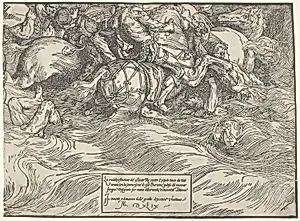
The Submersion of Pharaoh's Army in the Red Sea
c. 1515, printed 1549
Medium
Woodcut in black on ivory laid paper
Dimensions
40.8 × 55.5 cm (16 1/8 × 21 7/8 in.)
Classification
woodcut
Department
Prints and Drawings
Museum
Art Institute of Chicago
Accession Number
181315
Rights
Public Domain
About this artwork
The grand scale of Titian’s twelve-sheet woodcut (see 1957.12.1–12) mimics history paintings and large wall hangings. The assembled composition would fit only on a massive wall, a use confirmed by the total lack of early impressions. Only this 1549 state is known, printed from woodblocks studded with wormholes, which appear in the image as tiny white dots. The inscription at lower center of The Submersion describes the Israelites’ persecution under the Egyptian pharaoh and his army’s fate when t...
Art Historical Context
Behold the dramatic *The Submersion of Pharaoh's Army in the Red Sea*, a woodcut designed by the Renaissance master Titian around 1515 and printed in 1549. This monumental print, measuring 40.8 × 55.5 cm, captures the biblical climax from the Book of Exodus, where God's waters engulf Pharaoh's chariots and soldiers as Moses leads the Israelites to freedom. Housed in the Art Institute of Chicago's Prints and Drawings Department, it exemplifies Titian's early genius for dynamic composition, even in monochrome. Crafted as a woodcut in black ink on ivory laid paper—a relief printing technique where the artist carves into wood blocks to create bold contrasts—Titian's design showcases his Venetian flair for movement and depth. Though best known for lush oil paintings, Titian collaborated with expert engravers like Ugo da Carpi, translating his painterly vision into accessible prints. The 34-year gap between design and printing highlights the era's growing print culture, making high art available beyond elite patrons. This work's cultural resonance lies in its vivid retelling of divine triumph, a popular Renaissance motif amid religious fervor. Visitors will marvel at how Titian's swirling waves and flailing figures convey chaos and awe, bridging painting and print in High Renaissance innovation.
About the Artist
Titian · 1483–1576
Tiziano Vecellio (c. 1488-1576), known as Titian, was the greatest painter of the 16th-century Venetian school and one of the most influential artists in Western art history. Born in Pieve di Cadore in the Venetian Republic, Titian revolutionized painting through his innovative use of color, expressive brushwork, and mastery of oil technique. Trained in Giovanni Bellini's workshop alongside Giorgi...