
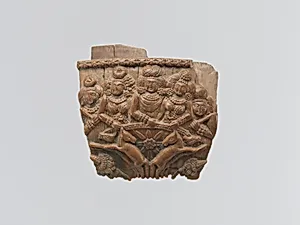
The Sun God Surya(?) in His Chariot with Wives and Attendants
Unknown Artist
2nd–1st century BCE
Medium
Ivory
Dimensions
H. 1 15/16 in. (5 cm); W. 2 1/8 in. (5.4 cm)
Classification
Ivories
Culture & Period
India (West Bengal), · Shunga period
Department
Asian Art
Museum
Metropolitan Museum of Art, New York, NY
Credit
Purchase, Friends of Asian Art Gifts, 2003
Accession Number
2003.457
Rights
Public Domain
Tags
Art Historical Context
This delicate ivory carving, titled *The Sun God Surya in His Chariot with and Attendants*, hails from India's Shunga period (2nd–1st century BCE) in West Bengal. Measuring a mere 1 15/16 inches and 2 1/8 inches wide, it a vibrant divine procession: the radiant Sun God, possibly Surya, rides in a chariot drawn by horses (suggested by animal motifs), flanked by his wives and attendants—men and women in flowing garments. The intricate scene buzzes with motion, evoking the god's daily journey across the sky. Crafted during the Shunga dynasty, which followed the Mauryan Empire, this artwork exemplifies the era's mastery of ivory as a luxury medium. Artisans carved fine details into the hard, smooth material, achieving lifelike figures and dynamic compositions on a pocket-sized scale—likely for personal devotion or elite adornment. Ivory's rarity and workability made it ideal for portable religious icons, highlighting advanced technical skill. Culturally, the piece reflects early Hindu iconography, where Surya symbolized light, vitality, and cosmic order. Such carvings offer a window into Shunga spiritual life, blending mythology with everyday artistry. Acquired by the Metropolitan Museum of Art in 2003 through Friends of Asian Art gifts, it remains a testament to ancient India's refined aesthetic sensibility.