
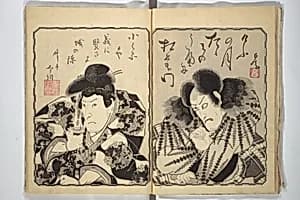
The Thirty-Six Immortals of Poetry as Kabuki Actors (Yakusha sanjūrokkasen) 役者三十六歌仙
1835, first month (Tempō 6)
Medium
Woodblock printed book; ink and color on paper
Dimensions
10 1/16 × 7 5/16 in. (25.6 × 18.5 cm)
Classification
Illustrated Books
Culture & Period
Japan · Edo period (1615–1868)
Department
Asian Art
Museum
Metropolitan Museum of Art, New York, NY
Credit
Purchase, Mary and James G. Wallach Foundation Gift, 2013
Accession Number
2013.761
Rights
Public Domain
Tags
Art Historical Context
In the vibrant world of Edo-period Japan, *The Thirty-Six Immortals of as Kabuki Actors (akusha sanjūrokkasen)*, published in 1835 by ukiyo-e masters Utagawa Kunisada Totoya Hokkei,fully bridges classical literature and popular theater. This woodblock-printed book, with its vivid ink and color on paper reimagines the revered Thirty-Six Immortals—legendary poets from Japan's Heian and medieval eras—as glamorous Kabuki performers. Each page bursts with dynamic portraits, capturing the actors' expressive poses, elaborate costumes, and theatrical flair, turning timeless verses into lively entertainment. Created during the Tempō era (1830–1844), amid strict censorship on actor prints, this work slyly celebrates Kabuki stars while honoring poetic heritage. Ukiyo-e techniques shine through precise woodblock carving and layering of colors, evoking the "floating world" of urban pleasures in 19th-century Tokyo. Kunisada's bold lines and Hokkei's subtle shading highlight the cultural fusion: highbrow poetry meets mass-appeal drama, reflecting Edo society's love for wit and spectacle. Measuring a compact 10 x 7 inches, this illustrated book from the Metropolitan Museum of Art invites you to ponder how art immortalizes both heroes of the page and the stage— a playful testament to Japan's enduring poetic and performative traditions.
About the Artist
Utagawa Kunisada 歌川国貞|Totoya Hokkei 魚屋北渓 (Japanese) · 1786 –1864
Japanese, 1786–1864