
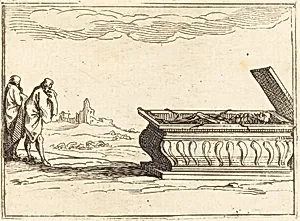
The Tomb
1628
Medium
etching on laid paper
Dimensions
plate: 5.9 × 9.1 cm (2 5/16 × 3 9/16 in.) sheet: 9.7 × 11.6 cm (3 13/16 × 4 9/16 in.)
Classification
Department
CG-E
Museum
National Gallery of Art, Washington, D.C.
Credit
Rosenwald Collection
Accession Number
1949.5.361
Rights
Public Domain
Art Historical Context
Step into the shadowy realm of *The Tomb*, a masterful etching created by Jacques Callot in 1628. Callot, a leading French printmaker of the Baroque era (1592–1635), was renowned for his extraordinary technical skill in capturing dramatic human scenes on a minuscule scale. This tiny plate—measuring just 5.9 × 9.1 cm—exemplifies his genius for intricate detail, likely evoking themes of mortality and the macabre amid the turmoil of the Thirty Years'. Etching on laid paper, the medium allowed Callot to etch fine lines into a metal plate with acid, producing richly textured images through cross-hatching and multiple states for depth and nuance. Laid paper, with its visible chain lines, was a hallmark of 17th-century printmaking, lending an artisanal authenticity to this reproducible yet intimate artwork. As part of the National Gallery of Art's Rosenwald Collection, it highlights the rise of prints as accessible art for collectors. *The Tomb* invites us to ponder life's fragility through Callot's precise, evocative lines—a poignant reminder of Baroque fascination with death and drama in an age of conflict. Pause and let its delicate intensity draw you closer.
About the Artist
Jacques Callot · 1592–1635
Jacques Callot (1592–1635) was a French printmaker and draftsman from the Duchy of Lorraine, widely regarded as one of the first great artists to practice the graphic arts exclusively. His more than 1,400 etchings chronicled the breadth of 17th-century life, from Medici court festivities to the brutal realities of warfare. Callot revolutionized etching through technical innovations including the é...