
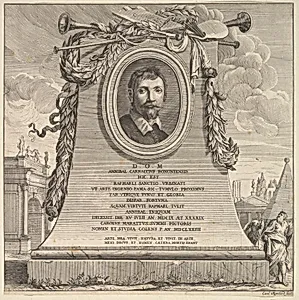
The Tomb of Annibale Carracci
Medium
Engraving and etching
Dimensions
sheet: 11 5/8 x 20 5/16 in. (29.6 x 51.6 cm) plate: 10 7/16 x 10 7/16 in. (26.5 x 26.5 cm)
Classification
Prints
Department
Drawings and Prints
Museum
Metropolitan Museum of Art, New York, NY
Credit
The Elisha Whittelsey Collection, The Elisha Whittelsey Fund, 1951
Accession Number
51.501.2647
Rights
Public Domain
Tags
Art Historical Context
Welcome to the Metropolitan Museum of Art's Drawings and Prints department, where *The Tomb of Annib Carracci* (1690–1735) stands as a poignant tribute to one of the Baroque era's luminaries. This engraving and etching, attributed to Annibale Carr alongside Carlo Maratti and Karl Remshardt, captures the of Carracci's tomb monument. Featuring elements like portraits of men and symbolic horns—possibly evoking abundance or fame—it immortalizes a funerary design likely from a Roman church, blending architecture, sculpture, and portraiture in a rectangular sheet format (11 5/8 x 20 5/16 in.). Annibale Carracci (c. 1560–1609), a Bolognese master who co-founded the revolutionary Carracci school, bridged Mannerism and the High Baroque with his naturalistic frescoes in Rome's Palazzo Farnese. Created decades after his death, this print reflects the enduring reverence for his legacy during the late 17th and early 18th centuries, when reproductive prints popularized such memorials across Europe. Maratti, a leading Roman academic artist, may have contributed to its design, underscoring the collaborative spirit of Italian printmaking. Engraving and etching techniques here allowed precise reproduction of intricate details—from draped figures to ornate tomb motifs—making elite art accessible to collectors. Part of The Elisha Whittelsey Collection (acquired 1951), this work highlights prints' role in cultural preservation, inviting us to reflect on how monuments keep genius alive.
About the Artist
Annibale Carracci|Carlo Maratti|Karl Remshardt · 1560–1609
Annibale was considered one of the greatest Italian painters of his age. His style is marked by naturalism combined with the formal language of Classicism in a grand and monumental style. Annibale was also instrumental in evolving the ideal, classical landscape and is generally credited with the invention of caricature. Italian painter. Comment on works: Mythology.