
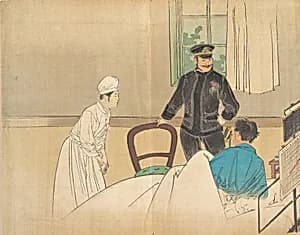
The Torpedo Officer (Suirai shikan), frontispiece illustration from the literary magazine Bungei kurabu, vol. 1, no. 8
Medium
Woodblock print; ink and color on paper
Dimensions
Album: 8 1/2 x 5 5/16 in. (21.6 x 13.5 cm)
Classification
Prints
Culture & Period
Japan · Meiji period (1868–1912)
Department
Asian Art
Museum
Metropolitan Museum of Art, New York, NY
Credit
Gift of Donald Keene, in honor of Julia Meech-Pekarik, 1986
Accession Number
JP3720
Rights
Public Domain
Tags
Art Historical Context
Kajita Hanko’s *The Torpedo Officer (Su shikan)* served as the striking frontispiece for the inaugural volume of *Bungei kurabu*, a prominent Japanese literary magazine from the Meiji period (1868–1912). This era marked Japan’s rapid modernization, blending traditional arts with Western influences amid naval expansion and wars like the Sino-Japanese conflict. Hanko, a illustrator known for his elegant depictions of women (*bijin-ga*), captured a dramatic scene likely evoking military valor and human tenderness—featuring men, women, beds, nurses, as suggested by thematic tags. Rendered as a woodblock print in ink and color on paper, the work exemplifies *shinpa* or transitional ukiyo-e styles, where carvers and printers collaborated to achieve vibrant hues and fine details on a compact album scale (8½ × 5⅜ in.). Frontispieces like this elevated magazine art, making literature accessible and visually compelling for a growing urban readership. Housed in the Metropolitan Museum of Art’s Asian Art department (gift of Donald Keene, 1986), it highlights Meiji cultural fusion: torpedoes symbolizing technological prowess, paired with intimate, narrative-driven imagery. A window into Japan’s evolving print culture, it invites visitors to ponder the interplay of war, romance, and artistry in a transformative age.