
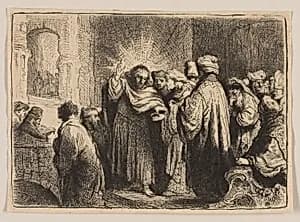
The Tribute Money
c. 1634
Medium
Etching in black on ivory laid paper
Dimensions
Image/plate, sight: 7.2 × 10.2 cm (2 7/8 × 4 1/16 in.); Sheet, sight: 7.6 × 10.6 cm (3 × 4 3/16 in.)
Classification
etching
Department
Prints and Drawings
Museum
Art Institute of Chicago
Accession Number
200626
Rights
Public Domain
Art Historical Context
In the Gospel of Matthew, Jesus instructs Peter to find a coin in a fish's mouth to pay the temple tax—an episode vividly captured in Rembrandt van Rijn's *The Tribute Money (c. 1634). This intimate etching, measuring just 7.2 × 10.2 cm, showcases the Dutch master's genius during his Amsterdam years, when he was revolutionizing printmaking amid the Dutch Golden Age. Rembrandt etched this scene on ivory laid paper using intricate lines and subtle cross-hatching to conjure dramatic chiaroscuro effects—deep shadows contrasting with glowing highlights that draw the eye to the central figures. As a pioneer of etching, he layered ink unevenly on the plate, achieving velvety tones and textures impossible in earlier techniques, making each impression uniquely rich. Housed in the Art Institute of Chicago's Prints and Drawings Department, this work exemplifies Rembrandt's Baroque flair for biblical storytelling with human emotion, inviting viewers to ponder faith and divine provision in a collector's gem that bridges art and spirituality.
About the Artist
Rembrandt van Rijn · 1606–1669
Rembrandt Harmenszoon van Rijn (1606–1669) stands as one of the greatest visual artists in the history of Western art and the most important Dutch painter of the 17th century. Born in Leiden to a prosperous miller's family, Rembrandt transformed painting through his revolutionary use of light and shadow, his psychological depth in portraiture, and his elevation of etching to a fine art. His approx...